Kyle Williams, Stefon Diggs and Mack Hollins

Sorting out the the 2025 New England Patriots WR Group
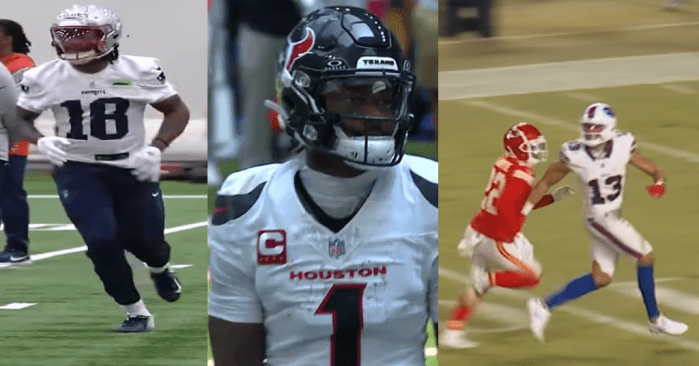
The New England Patriots will enter the 2025 season with a sense of renewed hope and optimism that has been absent over the past few years. In just the first offseason under new head coach Mike Vrabel, the roster has endured a rather dramatic makeover that has seen several additions and departures of long-time veterans and team captains.

With a young promising quarterback in Drake Maye, and Josh McDaniels returning for a third stint as offensive coordinator, things are expected to change, or rather, revert, to a familiar offense. The Patriots used their first three draft picks on the offensive side of the ball, and with mandatory minicamp soon approaching next month (June 9-11), focus will shift toward implementing McDaniels scheme, and the structuring of how the offense might look come Week 1 in early September.

To do that, the Patriots will need to figure out their wide receiver depth chart. At the moment, there is an unusual logjam at the receiver position. One could argue New England still lacks a top weapon, but between a bevy of returning members and newcomers, the team has around seven or eight receivers that project as 53-man roster options in many NFL teams’ five-receiver depth charts.

In figuring out where players may project within the offense, it’s best to start with what receiver roles may be present within the offense McDaniels is implementing for Maye and company.

Using charting data from PFF, I was able to glean three fairly distinct receiver alignment roles under Josh McDaniels during the three-season stretch from 2020 through 2022. This time included the final two years of McDaniels’s second offensive coordinator stint in New England (2020-2021), and his only full season as head coach of the Las Vegas Raiders (2022). These three seasons are not only McDaniels most recent campaigns as a full-time coach, but they’re also key in analyzing and projecting receiver roles, particularly in a post-Tom Brady McDaniels-led offense.

Role 1 (X-receiver)

Year/Team Player Snap % Wide Snap % Slot Snap % aDot (average depth of target in yards)
2020 Patriots Damiere Byrd 89% 91% 9% 12
2021 Patriots Nelson Agholor 64% 90% 10% 14.8
2021 Patriots N’Keal Harry 30% 87% 13% 14.8
2022 Raiders Mack Hollins 94% 86% 14% 13.1

– This was a fairly easy role to identify between charting data and sampled film watching. This is by and large a boundary X-receiver deployment and downfield/vertical role in both 2-WR sets and 3-WR sets, with little alignment versatility. And as opposed to the heavy usage of condensed formations in Kyle Shanahan/Sean McVay tree offenses, McDaniels typical uses wider spacing or formational width, with receivers in this role truly lining up out wide.

– Despite the X-role, none of the receivers above were top playmakers within their offense. There’s a diverse set of skills, body builds and player archetypes in this hodgepodge group. Damiere Byrd’s size for this role was an anomaly (5-9, 175 pounds), but he ran a 4.28 40 at his Pro Day. Mack Hollins carved out a boundary role in the 2022 Raiders offense, and has the requisite size (6-4, 221), but doesn’t necessarily have the explosiveness for the position.

– Nelson Agholor’s best season as a pro came in 2017 for the Super Bowl champion Philadelphia Eagles, where he spent 86.2% of snaps that season in the slot. After signing with the Patriots, New England used him on the outside for a career-high 90% percentage of snaps for a season. For reference, Agholor has spent 66% of his snaps in the slot in Baltimore over his last two seasons. Toward the end of the year, N’Keal Harry began cutting into his snaps at the position, which is reflected in his similar snap alignment and identical aDot metric.

Roles 2 & 3 (Alignment versatility, Z vs Slot, 2-WR set vs. 3-WR set roles)

Year/Team Player Snap % Wide Snap % Slot Snap % aDot (average depth of target in yards)
2020 Patriots N’Keal Harry 58% 63% 36% 8.4
2021 Patriots Kendrick Bourne 52% 62% 37% 8.5
2022 Raiders Davante Adams 95% 70% 30% 12.8
Year/Team Player Snap % Wide Snap % Slot Snap % aDot (average depth of target in yards)
2020 Patriots Jakobi Meyers 66% 40% 60% 10.6
2020 Patriots Julian Edelman 26% 25% 75% 10.9
2021 Patriots Jakobi Meyers 84% 34% 66% 9.8
2022 Raiders Hunter Renfrow 34% 14% 86% 6.5
2022 Raiders Keelan Cole Jr. 34% 37% 63% 17.3

– A McDaniels offense is known for operating from the inside out through its slot receivers and tight ends. There’s essentially two different roles here – one with 60-70% of snaps spent outside, and the other with 60-70% of snaps in the slot. Things get a bit too complicated to identify these roles as just ‘Z’ receiver and slot. And there’s some overlap in the above examples on which style of receiver (in terms of deployment/charting data) is used in 2-WR sets.

– We’ll start with Davante Adams, who was still an elite receiver in 2022 in Las Vegas. No receiver in this data or on the current Patriots roster is even close to the level of Adams in 2022, who led the NFL in receiving TDs (14) with 1,516 receiving yards on a career-high 180 targets. For context, in that same 2022 season, Jakobi Meyers led the Patriots with 96 targets. McDaniels deployment of Adams is notable and worth revisiting if the Patriots add a top-flight WR1 in 2026 or beyond. Adams was moved all around the formation and used as a vertical threat in 2022, where he posted a career-high 12.8 aDot.

– The high-volume “WR1” role from a targets perspective has often been the hybrid Z/slot role under McDaniels in New England. This player is primarily a receiver who operates mostly inside on underneath to intermediate routes, both from the slot and off the line on the outside, where the player would often come in motion pre-snap. This receiver would be the flanker in 2-WR sets and often would play in the slot or as a Z-receiver in 3-WR sets or spread looks. Julian Edelman occupied that role for most of his career. Many often lump Edelman, Danny Amendola and Wes Welker as similar players, but remember, both Edelman and Amendola co-existed in the same McDaniels offense for years. Amendola (and Welker) spent over 80% of his career snaps in the slot. Edelman had a role in 2-WR sets and he spent a lesser 55% of his career snaps in the slot, but as he suffered an ACL tear and aged into his 30s, he began to spend more time inside.

– Edelman, then age 34, began the 2020 season as primarily a slot receiver with Cam Newton at the helm, working alongside Damiere Byrd (X) and N’Keal Harry (Z). After six games, Edelman went on IR and later retired that offseason. Between Edelman’s injury and Harry failing to carve out a role as a jumbo Z/move-receiver, Jakobi Meyers took the baton as the new top target. Meyers played more snaps than any other Patriots receiver from Week 8 on in 2020, and then paced the entire depth chart again in 2021 with Mac Jones at QB. He operated as both a slot receiver and as a flanker in two-WR sets. McDaniels eventually signed Meyers away from New England to Las Vegas in 2023.

– Elsewhere, Kendrick Bourne served as a Z-receiver in 2021 in New England in 3-WR sets, working in unison with Meyers as a more productive YAC target on screens, reverses and other designed targets, where as Meyers was given more of the focal routes on key third downs. In 2022 in Las Vegas, Hunter Renfrow worked as a static slot receiver in 3-WR sets, similar to Amendola, and Keelan Cole Jr. mixed in as a vertical slot option who could also play on the outside. Cole led the Raiders in aDOT (17.3) that season and there wasn’t much overlap between him and Renfrow being used on the field at the same time. Renfrow or Cole’s presence on the field probably helped dictate Adams’ pre-snap deployment to a degree that season.

Projecting Patriots 2025 WR Depth Chart

Here is where it gets fun. The first question I pondered with this assignment is – how different will this version of McDaniels offense look with Drake Maye? And after consideration, I really don’t expect the tentpoles of his offense to change that much. Even in his lone full season as Raiders head coach in 2022, which included the force-feeding of targets through the air to Davante Adams, McDaniels still found ample snaps for Josh Jacobs to lead the league in rushing yards (1,653) and gap run concepts (201), per PFF.

This season, I expect New England to either utilize a fullback or run 12 personnel (2-TE sets) to play smash mouth football, run power concepts with pulling guards, and feature play-action passing elements that mimic their gap runs. This means there will be an assortment of 2-WR packages, allowing the distinction of which receivers are worthy of playing in 2-WR sets vs operating in 3-WR sets and other spread looks. Still, like most modern offenses, there should be a heavy dose of 11 personnel groupings, and although I don’t expect the offense to take on any major changes from what Patriots fans are accustomed to, I imagine there will be an uptick of shotgun usage to compliment Maye’s experience and play style. New England may also implement packages and formations that feature zone-read, QB power or other designed QB run concepts like what was seen with Cam Newton at the helm in 2020.

But by and large, this should be a familiar offense. So which of the many receivers currently on the roster will be featured?

2-WR Sets
X  Kyle Williams  Mack Hollins  Javon Baker
Z  Stefon Diggs  Kendrick Bourne  Ja’Lynn Polk
3-WR Sets
X  Kyle Williams  Mack Hollins  Javon Baker
Z  Stefon Diggs  Kendrick Bourne  Kayshon Boutte
Slot  DeMario Douglas  Ja’Lynn Polk  Efton Chism

– History has not been kind to the Patriots this century when it comes to drafting WRs, but their selection of Kyle Williams in the third round last month drew heaping praise from the NFL Draft community. His blend of speed, downfield explosiveness, acceleration and YAC ability make him a three-level threat from multiple alignments. But even at his size (5-11, 190 lbs), Williams’ ability on tape in college at the X-receiver spot, paired with New England’s need at the position, set him up with a unique opportunity as a Day 2-drafted rookie.

– There’s some history with smaller X-receivers both at the All-Pro/Hall-of-Fame level (Antonio Brown), solid/near Pro Bowl level (Deion Branch) and serviceable level (see Damiere Byrd in 2020 referenced earlier). Branch in New England in 2002-2005 is a good example of how a smaller, shiftier X-receiver fares in an offense such as the one we’ll see this year. McDaniels took over play-calling duties from Charlie Weis in the Patriots Erhardt-Perkins style offense in 2005. Kyle Williams doesn’t quite possess the shiftiness and nuance of Branch then, but he packs more of an explosive punch as a potential vertical separator.

Kyle Williams spent 74% of his snaps out wide for Washington State last year, and per PFF, he led his draft class with 8.4 YAC per reception (min. 75 targets). According to PFF, Williams was also in the 85th percentile or better in YPPR (yards per route run) on go routes, on screens and on hitch routes in FBS play in 2024, and he was over the 90th percentile both versus man coverage and when lined up in the slot (26% of snaps). Those marks alone exhibit his diverse skill set. He has the ability to line up inside or off-the-line as a flanker, but by midseason, I project Williams to be the team’s top outside receiver in both 2-WR and 3-WR sets.

Mack Hollins made some big catches for Buffalo late last season, and his breakout year as a receiver was as a perimeter player for McDaniels in Las Vegas in 2022. But Hollins will turn 32 in September. There will be a need for more explosiveness at the position. As it stands, he has a solid chance of being New England’s Week 1 starting X-receiver, at least in 3-WR sets and red zone looks as a jump ball operator, while Williams gets acclimated. Hollins is also a willing and able blocker, experienced special teamer, and he brings a vibe of toughness that Vrabel is looking for. But if the offense is to be at its best, he will serve as more of a rotating X-receiver and in a WR4-type role as the season progresses.

– It appears there’s a chance Stefon Diggs may be ready by Week 1. In his eight weeks on the field last season for the Texans before tearing his ACL, he operated in both 2-WR (Z) and 3-WR sets (slot). He tallied 47 catches during that spurt and finished the year 2nd among WRs in ESPN‘s receiver score metric. But Diggs will turn 32 in November. His age and recent injury suggest he’ll be a different player than in his prime years. Last year was the first time since 2016 where he was charted more in the slot (52.8%) than outside (45.1%), but he still played on the perimeter quite a bit, although some of his “outside” snaps were in Bobby Slowik’s Shanahan/McVay-esque condensed formations.

– There are several receivers who remained tough, higher-volume options well into their 30s, including Anquan Boldin, Steve Smith, Larry Fitzgerald and Julian Edelman. All of these receivers saw a significant increase in snaps in the slot as their career continued. Stefon Diggs was once a X-receiver, but there’s a prime opportunity here late in his career to occupy the high-volume hybrid Z/Slot role occupied by Julian Edelman and more recently, Jakobi Meyers. His inside-outside split could veer around 60:40 in either direction, but I expect Diggs to be a factor as a Z-recevier in 2-WR sets.

Kendrick Bourne and Kayshon Boutte could each have major roles come Week 1 or be off the roster entirely. There’s too much of a logjam here to make any promises. Bourne projects best as a fill-in for Diggs’ reps if the former Bills-Vikings receiver is unable to go Week 1. It’s not 1:1 fill-in, as I see Bourne as mostly a Z-receiver only in 2-WR and 3-WR sets as opposed to a high-volume slot-hybrid role. Bourne’s prime was sort of mismanaged in New England as I thought he had a chance to have a monster year in 2022 as both an inside and outside receiver after showing flashes in the McDaniels offense as a move-piece in 2021. Now, Bourne enters his age-30 season in a strange position considering the additions. I wonder if he’d be an option for a team like the Rams who lack a proven WR3. As for Boutte, he played admirably last year logging more snaps than any New England WR (760) as mostly a X-receiver. He had some moments, but his best role is likely a WR4-type snap count, maybe even as a Z-receiver who can work off the line, but often outside, where he’ll be given more space to operate as a YAC threat. I’m not sure I see a clear fit here in the McDaniels offense considering the state of this depth chart. It was already reported by Adam Schefter before the draft that Boutte may be available or “expendable.”

– DeMario Douglas was first among Patriots WRs in receptions last season (66), and was second on the team in targets (87) and receiving yards (621), behind tight end Hunter Henry. There’s a prime opportunity for him to take on a Danny Amendola or Hunter Renfrow-esque role as the team’s slot receiver in 11 personnel. Like Amendola and Renfrow, Douglas is best used as a slot-only option who plays 80% or more of his snaps inside. Although much more explosive than Amendola or Renfrow, Douglas lacks a bit of the route-running nuances (‘sit’ routes in zone coverage) needed for this role, and despite his speed, he’s still much too undersized (5-8, 192) to play Z-receiver snaps in 2-WR sets. One blocker for Douglas may be the eventual heavy usage of a hypothetical 3-WR set of Mack Hollins (X), Kendrick Bourne/Kyle Williams (Z) and Stefon Diggs (slot/Z) where Diggs almost fully occupies the slot role.

Ja’Lynn Polk‘s rookie campaign was a year he’d like to forget. The Patriots didn’t do him any favors with his usage as mostly a X-receiver (80% of snaps out wide) in a struggling offense with a patchwork offensive line. I think there is room for six WRs on this roster, and with the possible exodus with guys like Bourne and Boutte by Week 1, paired with his recent draft status as a second-round pick, I think it’s likely Polk is on the roster come Week 1. He deserves a shot to see how he fares in McDaniels’ offense. He has the profile of a stockier Jakobi Meyers-type who can play the Z and slot-receiver roles and win at the catch point (he has historically had great hands). He’ll likely need to work behind the scenes to earn playing time, and if not, I wonder if it’s best if he was traded in August to a Shanahan tree team where he’d be given the chance to revive his career in condensed formation looks and roles that I think would suit him well.

– Elsewhere, both Javon Baker and Efton Chism are noteworthy as receivers attempting to make the roster. Chism is a classic, McDaniels offense-style shifty slot receiver who moves really well. Baker has the potential to earn a spot as a rotational or depth option as a X-receiver considering the small amount of options on the roster, but he has an uphill battle.

Aaron Rodgers vs Rams - 2021

NFL Monday Morning Madness Week 12: Are Packers the league’s most complete team?

GREEN BAY, Wis. — In a season where no team has been consistently good, or even consistent, the Green Bay Packers (9-3) are starting to show their teeth as perhaps the NFC’s most complete club.

The Cheeseheads, led by Aaron Rodgers (28 of 45, 307 yards, 2 TD, 0 INT) defeated the Los Angeles Rams (7-4), 36-28, in a game that wasn’t as close as its final score, as Green bay looked like a much better squad than the star-studded Rams.

Green Bay led the Rams 36-17 heading into the fourth quarter, and held Los Angeles to 68 rush yards (3.4 yards per carry), forcing three turnovers (including a pick-six of Matthew Stafford), and in several big moments, Rodgers found superstar receiver Davante Adams (eight catches, 104 yards) seemingly with ease, as the Rams’ zone-heavy scheme foolishly did not feature cornerback Jalen Ramsey shadowing Adams throughout the entire game.

The game also shed light on the puzzle of Rodgers’ future. Some said that Rodgers was justified in his offseason frustration over Green Bay’s roster construction. Green Bay lacked a solid pass catcher after Adams, and in the 2020 NFL Draft, they seemingly drafted Rodgers’ eventual replacement in the first round (quarterback Jordan Love) and drafted a bulldozing, old-school running back (A.J. Dillon) in Round 2.

Rodgers insisted the 2020 draft was not the issue, and that it was Green Bay’s overall way of handling many offseasons, that irked him.

“It’s never been about the draft pick,” Rodgers told ESPN‘s Kenny Mayne in his final SportsCenter appearance.

“I love Jordan. I love the coaching staff. I love my teammates. It’s just about a philosophy and maybe forgetting it is about the people that make things go.”

Rodgers eventually agreed to return to the team for this season, and was given a gift in Green Bay’s acquiring of Rodgers’ long-time friend, slot receiver Randall Cobb, via trade.

Many believe Rodgers will attempt to leave Green Bay this offseason. And that may very well be the case. But looking at the lay of the land as it stands, why would he leave?

What type of team does Rodgers want to play for, exactly? A squad like the Rams, top-heavy team, lacking depth and consistency.  Does he want a wheeling-and-dealing squad that constructs its roster only for its quarterback? Or does he want to win a Super Bowl. If the latter still matters to him, then Rodgers must see that the Packers are close.

Together, Rodgers and head coach Matt Lafleur are 35-8 in the last three regular seasons, which is good for best in the NFL. The Packers have also made the NFC title game in the last two seasons. They’ve failed to get past that round, but history shows great teams such as this one sometimes enjoy a “breakthrough” season in the midst of two or three consecutive near-berths to a Super Bowl.

Rodgers, after struggling some in 2019 in LaFleur’s Shanahan-style offense, now has acclimated perfectly, as the team uses a mix of under-center, run-heavy, two-tight end sets, and spread-you-out, passer-friendly looks to compliment Rodgers’ career-long strengths.

Green Bay GM Brian Gutekunst has taken the brunt of Rodgers’ frustration via pass-aggressive quotes in the offseason, but the fourth-year general manager has carried the torch of the franchise’s past, relying heavily on the franchise’s scouting department to emphasize the need to build through the draft, focus on internal player progression, and prioritize homegrown players over free agents.

That style has worked for one of the NFL’s best franchises for years and years. Like the Pittsburgh Steelers, Green Bay has their own way of doing things. Their stubbornness in their ways caught up with them some during the middle of the last decade, as Rodgers was stuck attempting to elevate lesser-talented teams (think: 2016 season).

But Green Bay has built a solid roster up from the ground, with just the right mix of free agents to help lead the way.

A.J. Dillon vs Rams -- 2021
A.J. Dillon has been a breakout star for the Packers in 2021. He’s the perfect running back for the weather in Green Bay, and the Packers’ rushing scheme. (Screenshot: NFL on FOX)

A.J. Dillon, in particular, has had a breakout season in Year 2. The Boston College product is a bully-ball rusher who is perhaps in the perfect spot in snowy Wisconsin. He’s the type of January running back that was needed, but many scoffed at the draft pick two years ago.

Rodgers is still making due with a modst-at-best receiving group after Adams, but with the cap room to spread talent throughout the roster, Green Bay at least has Adams, maybe the best receiver in football, as well as a solid offensive line, and now, one of the NFL’s best defenses.

In 2019, Green Bay paid front seven members Za’Darius and Preston Smith, as sell as safety Adrian Amos, to help a defense that needed reinforcements. The moves have paid dividends, with Amos teaming up with homegrown safety Darnell Savage to rival Buffalo (Micah Hyde, Jordan Poyer), as perhaps the best safety tandem in the league.

Up front, the Packers play mostly a 3-4 style defense built with tough, bigger players (somewhat like other well run-franchises in the Patriots and Steelers) that relies on a few players such as top-tier nose tackle Kenny Clark to take up bodies and make plays up front, clearing the way for others.

Green Bay is currently seventh in the league in yards per game allowed (321.7) and fifth in points allowed (20.2). They’ve built up a Super Bowl caliber defense, and they aren’t even at full strength as a team at the moment.

Za’Darius Smith has been out since September with a back injury, but should be back soon.

Green Bay is also expecting the return of left tackle David Bakhtiari and cornerback Jaire Alexandler, two former All-Pros who are undoubtedly top-five players at their respective positions, sometime during their home stretch.

Alexander, much like Adams on offense, is a good example of how well Green Bay progresses their players.

To get back to Sunday’s game, the difference between the Packers and Rams was stark.

As great of a head coach and X’s and O’s man Sean McVay is, he’s stumbled as of late, as has his hand-picked quarterback, Matthew Stafford, who fell to 0-17 in his career against teams who entered a contest five games over .500 (via NFL research). It was the fourth loss to Aaron Rodgers and the Packers for Stafford in such a situation.

The Rams have loads of top-end talent. Even Odell Beckham Jr. scored his first touchdown in over a year in the fourth quarter of the Rams’ comeback attempt. But what the Rams don’t have, is a steady roster across the board. Players one to 53, the practice squad, the team history, the scouting and player personnel department, the January, cold-weather homefield advantage.

In Green Bay, Rodgers just may have it all now, or close to it. The way the Packers’ season ends will have much to do with his decision. If Green Bay’s rushing attack is foiled, and Adams is blanketed in the same playoff game, Rodgers will identify that the problem is a lack of offensive weapons, and that may be true. But right now, in a year of mayhem, he has yet another prime shot at a second Super Bowl title with the team he’s played for, for 17 seasons.

THE BETTER HALF

1. Green Bay Packers (9-3) (Last week: 3). Along with the Patriots, they look like the league’s most complete team at the moment. And Aaron Rodgers is now back in the MVP conversation, surely.

2. Tampa Bay Buccaneers (8-3) (Last week: 2). They survived Indianapolis behind a turn-back-the-clock performance by Rob Gronkowski (seven catches, 123 yards) and a dominant effort by Leonard Fournette (131 total yards, four touchdowns). Oh, and Tom Brady led his 65th career game-winning drive (including playoffs). Still, they need to get healthier on defense, and find their groove on that side of the ball.

3. Arizona Cardinals (9-2) (Last week: 4). Kyler Murray should return this week. They’re starting to slip under the radar, but they still have the league’s best record.

4. Kansas City Chiefs (7-4) (Last week: 5). The Chiefs have improved steadily on offense during their four-game winning streak, and their once-awful defense has allowed just 11.8 points per game during that span. The madness of this season, and in the AFC in particular, left the door open for the Chiefs. It appears they’ve found their way in the room.

5. New England Patriots (8-4) (Last week: 6). This is eerily starting to look like many of the Super Bowl-winning Patriots teams throughout the dynasty. Sunday’s 36-13 win over Tennessee under the cold weather and snow flurries felt like a vintage post-Thanksgiving New England win. Everything is coming together. But their biggest test lies ahead. Their Monday night game in Buffalo next week is perhaps their biggest regular season matchup since 2018.

6. Los Angeles Rams (7-4) (Last week: 1). They’ve lost three straight, and Matthew Stafford (three games in a row with a pick-six) hasn’t played well as of late. They have too much talent to not right the ship. They have good enough players to where suggesting they could make a 2020 Buccaneers-like run is not out of the question.

7. Buffalo Bills (7-4) (Last week: 8). One of the bigger AFC East regular season games in recent memory awaits them on Monday Night Football next week. Patriots at Bills. Can Buffalo limit turnovers, stay balanced on offense, and play good enough defense to win? It should be a great game.

8. Baltimore Ravens (8-3) (Last week: 9). They really haven’t looked consistently good all season, but they’re the AFC’s No. 1 seed at the moment anyway. That’s probably a good sign. They’re too well-run of an organization not to tighten things up here soon.

9. Tennessee Titans (8-4) (Last week: 7). When healthy, the Titans are a Super Bowl contender. Missing their three best offensive weapons in New England (Derrick Henry, A.J. Brown, Julio Jones), Mike Vrabel’s bunch held tough, before three turnovers ruined their upset chances. Still, they ran for 270 yards versus one of the team’s stingiest defenses. Their goal now is to get healthy for the playoffs. They have the mental toughness and coaching to surprise some people then.

10. Dallas Cowboys (7-4) (Last week: 10). They have the NFC East pseudo wrapped-up, but that doesn’t excuse their diminishing play as of late. Are they a Super Bowl contender, or will they just be happy to be ousted easily in the NFC Divisional round?

11. Indianapolis Colts (6-6) (Last week: 11). Carson Wentz threw for three touchdowns in the first half as the Colts looked primed for a major home upset over the defending champs, before the wheels came off. He lost a fumble and threw a pick in consecutive drives starting with Indy leading 24-14 and driving in Tampa territory. This is a built-for-January team, but often times, they are being held back by their QB. But sometimes, they are elevated by Wentz and his talent. They need more consistency from their quarterback.

12. San Francisco 49ers (6-5) (Last week: 12). Here come the 49ers. They’re getting much better (albeit, still Jekyll-and-Hyde) play out of Jimmy Garoppolo as of late, and receiver-running back Deebo Samuel has probably entered the OPOY discussion with Cooper Kupp and Jonathan Taylor for what he’s done as of recent.

13. Cincinnati Bengals (7-4) (Last week: NR). It’s hard to get a read on them. It seems as if they are good. That’s two big wins in a row for Joe Burrow and the gang. Joe Mixon (12 touchdowns in last eight games) has been a great compliment to their passing game as of late.

14. Minnesota Vikings (5-6) (last week: 15). They’re the only team in the league to lead each game they’ve played this year by seven points or more, yet they are 5-6. They’re snake-bitten, but the state of the NFC, and their remaining schedule (Lions, Bears (twice)) gives them a good shot at a wild card spot. This is a bad, good team. They have talent.

15. Las Vegas Raiders (6-5) (Last week: NR). I’m not sure they have what it takes to even make the playoffs, but when he is on, Derek Carr is one of the best passers in the league. That was a big overtime win in Dallas, for the most-watched regular season NFL game in league history.

16. Cleveland Browns (6-6) (Last week: 16). They’ve been horrid on offense as of late, but they still have the defense and potential in the running game for me to feel good about putting them above the teams below. Can they right the ship?

Next Up: Denver, L.A. Chargers, New Orleans, Miami, Pittsburgh