Kyle Williams, Stefon Diggs and Mack Hollins

Sorting out the the 2025 New England Patriots WR Group
The New England Patriots will enter the 2025 season with a sense of renewed hope and optimism that has been absent over the past few years. In just the first offseason under new head coach Mike Vrabel, the roster has endured a rather dramatic makeover that has seen several additions and departures of long-time veterans and team captains.

With a young promising quarterback in Drake Maye, and Josh McDaniels returning for a third stint as offensive coordinator, things are expected to change, or rather, revert, to a familiar offense. The Patriots used their first three draft picks on the offensive side of the ball, and with mandatory minicamp soon approaching next month (June 9-11), focus will shift toward implementing McDaniels scheme, and the structuring of how the offense might look come Week 1 in early September.

To do that, the Patriots will need to figure out their wide receiver depth chart. At the moment, there is an unusual logjam at the receiver position. One could argue New England still lacks a top weapon, but between a bevy of returning members and newcomers, the team has around seven or eight receivers that project as 53-man roster options in many NFL teams’ five-receiver depth charts.

In figuring out where players may project within the offense, it’s best to start with what receiver roles may be present within the offense McDaniels is implementing for Maye and company.

Using charting data from PFF, I was able to glean three fairly distinct receiver alignment roles under Josh McDaniels during the three-season stretch from 2020 through 2022. This time included the final two years of McDaniels’s second offensive coordinator stint in New England (2020-2021), and his only full season as head coach of the Las Vegas Raiders (2022). These three seasons are not only McDaniels most recent campaigns as a full-time coach, but they’re also key in analyzing and projecting receiver roles, particularly in a post-Tom Brady McDaniels-led offense.

Role 1 (X-receiver)

Year/Team Player Snap % Wide Snap % Slot Snap % aDot (average depth of target in yards)
2020 Patriots Damiere Byrd 89% 91% 9% 12
2021 Patriots Nelson Agholor 64% 90% 10% 14.8
2021 Patriots N’Keal Harry 30% 87% 13% 14.8
2022 Raiders Mack Hollins 94% 86% 14% 13.1

– This was a fairly easy role to identify between charting data and sampled film watching. This is by and large a boundary X-receiver deployment and downfield/vertical role in both 2-WR sets and 3-WR sets, with little alignment versatility. And as opposed to the heavy usage of condensed formations in Kyle Shanahan/Sean McVay tree offenses, McDaniels typical uses wider spacing or formational width, with receivers in this role truly lining up out wide.

– Despite the X-role, none of the receivers above were top playmakers within their offense. There’s a diverse set of skills, body builds and player archetypes in this hodgepodge group. Damiere Byrd’s size for this role was an anomaly (5-9, 175 pounds), but he ran a 4.28 40 at his Pro Day. Mack Hollins carved out a boundary role in the 2022 Raiders offense, and has the requisite size (6-4, 221), but doesn’t necessarily have the explosiveness for the position.

– Nelson Agholor’s best season as a pro came in 2017 for the Super Bowl champion Philadelphia Eagles, where he spent 86.2% of snaps that season in the slot. After signing with the Patriots, New England used him on the outside for a career-high 90% percentage of snaps for a season. For reference, Agholor has spent 66% of his snaps in the slot in Baltimore over his last two seasons. Toward the end of the year, N’Keal Harry began cutting into his snaps at the position, which is reflected in his similar snap alignment and identical aDot metric.

Roles 2 & 3 (Alignment versatility, Z vs Slot, 2-WR set vs. 3-WR set roles)

Year/Team Player Snap % Wide Snap % Slot Snap % aDot (average depth of target in yards)
2020 Patriots N’Keal Harry 58% 63% 36% 8.4
2021 Patriots Kendrick Bourne 52% 62% 37% 8.5
2022 Raiders Davante Adams 95% 70% 30% 12.8
Year/Team Player Snap % Wide Snap % Slot Snap % aDot (average depth of target in yards)
2020 Patriots Jakobi Meyers 66% 40% 60% 10.6
2020 Patriots Julian Edelman 26% 25% 75% 10.9
2021 Patriots Jakobi Meyers 84% 34% 66% 9.8
2022 Raiders Hunter Renfrow 34% 14% 86% 6.5
2022 Raiders Keelan Cole Jr. 34% 37% 63% 17.3

– A McDaniels offense is known for operating from the inside out through its slot receivers and tight ends. There’s essentially two different roles here – one with 60-70% of snaps spent outside, and the other with 60-70% of snaps in the slot. Things get a bit too complicated to identify these roles as just ‘Z’ receiver and slot. And there’s some overlap in the above examples on which style of receiver (in terms of deployment/charting data) is used in 2-WR sets.

– We’ll start with Davante Adams, who was still an elite receiver in 2022 in Las Vegas. No receiver in this data or on the current Patriots roster is even close to the level of Adams in 2022, who led the NFL in receiving TDs (14) with 1,516 receiving yards on a career-high 180 targets. For context, in that same 2022 season, Jakobi Meyers led the Patriots with 96 targets. McDaniels deployment of Adams is notable and worth revisiting if the Patriots add a top-flight WR1 in 2026 or beyond. Adams was moved all around the formation and used as a vertical threat in 2022, where he posted a career-high 12.8 aDot.

– The high-volume “WR1” role from a targets perspective has often been the hybrid Z/slot role under McDaniels in New England. This player is primarily a receiver who operates mostly inside on underneath to intermediate routes, both from the slot and off the line on the outside, where the player would often come in motion pre-snap. This receiver would be the flanker in 2-WR sets and often would play in the slot or as a Z-receiver in 3-WR sets or spread looks. Julian Edelman occupied that role for most of his career. Many often lump Edelman, Danny Amendola and Wes Welker as similar players, but remember, both Edelman and Amendola co-existed in the same McDaniels offense for years. Amendola (and Welker) spent over 80% of his career snaps in the slot. Edelman had a role in 2-WR sets and he spent a lesser 55% of his career snaps in the slot, but as he suffered an ACL tear and aged into his 30s, he began to spend more time inside.

– Edelman, then age 34, began the 2020 season as primarily a slot receiver with Cam Newton at the helm, working alongside Damiere Byrd (X) and N’Keal Harry (Z). After six games, Edelman went on IR and later retired that offseason. Between Edelman’s injury and Harry failing to carve out a role as a jumbo Z/move-receiver, Jakobi Meyers took the baton as the new top target. Meyers played more snaps than any other Patriots receiver from Week 8 on in 2020, and then paced the entire depth chart again in 2021 with Mac Jones at QB. He operated as both a slot receiver and as a flanker in two-WR sets. McDaniels eventually signed Meyers away from New England to Las Vegas in 2023.

– Elsewhere, Kendrick Bourne served as a Z-receiver in 2021 in New England in 3-WR sets, working in unison with Meyers as a more productive YAC target on screens, reverses and other designed targets, where as Meyers was given more of the focal routes on key third downs. In 2022 in Las Vegas, Hunter Renfrow worked as a static slot receiver in 3-WR sets, similar to Amendola, and Keelan Cole Jr. mixed in as a vertical slot option who could also play on the outside. Cole led the Raiders in aDOT (17.3) that season and there wasn’t much overlap between him and Renfrow being used on the field at the same time. Renfrow or Cole’s presence on the field probably helped dictate Adams’ pre-snap deployment to a degree that season.

Projecting Patriots 2025 WR Depth Chart

Here is where it gets fun. The first question I pondered with this assignment is – how different will this version of McDaniels offense look with Drake Maye? And after consideration, I really don’t expect the tentpoles of his offense to change that much. Even in his lone full season as Raiders head coach in 2022, which included the force-feeding of targets through the air to Davante Adams, McDaniels still found ample snaps for Josh Jacobs to lead the league in rushing yards (1,653) and gap run concepts (201), per PFF.

This season, I expect New England to either utilize a fullback or run 12 personnel (2-TE sets) to play smash mouth football, run power concepts with pulling guards, and feature play-action passing elements that mimic their gap runs. This means there will be an assortment of 2-WR packages, allowing the distinction of which receivers are worthy of playing in 2-WR sets vs operating in 3-WR sets and other spread looks. Still, like most modern offenses, there should be a heavy dose of 11 personnel groupings, and although I don’t expect the offense to take on any major changes from what Patriots fans are accustomed to, I imagine there will be an uptick of shotgun usage to compliment Maye’s experience and play style. New England may also implement packages and formations that feature zone-read, QB power or other designed QB run concepts like what was seen with Cam Newton at the helm in 2020.

But by and large, this should be a familiar offense. So which of the many receivers currently on the roster will be featured?

2-WR Sets
X  Kyle Williams  Mack Hollins  Javon Baker
Z  Stefon Diggs  Kendrick Bourne  Ja’Lynn Polk
3-WR Sets
X  Kyle Williams  Mack Hollins  Javon Baker
Z  Stefon Diggs  Kendrick Bourne  Kayshon Boutte
Slot  DeMario Douglas  Ja’Lynn Polk  Efton Chism

– History has not been kind to the Patriots this century when it comes to drafting WRs, but their selection of Kyle Williams in the third round last month drew heaping praise from the NFL Draft community. His blend of speed, downfield explosiveness, acceleration and YAC ability make him a three-level threat from multiple alignments. But even at his size (5-11, 190 lbs), Williams’ ability on tape in college at the X-receiver spot, paired with New England’s need at the position, set him up with a unique opportunity as a Day 2-drafted rookie.

– There’s some history with smaller X-receivers both at the All-Pro/Hall-of-Fame level (Antonio Brown), solid/near Pro Bowl level (Deion Branch) and serviceable level (see Damiere Byrd in 2020 referenced earlier). Branch in New England in 2002-2005 is a good example of how a smaller, shiftier X-receiver fares in an offense such as the one we’ll see this year. McDaniels took over play-calling duties from Charlie Weis in the Patriots Erhardt-Perkins style offense in 2005. Kyle Williams doesn’t quite possess the shiftiness and nuance of Branch then, but he packs more of an explosive punch as a potential vertical separator.

Kyle Williams spent 74% of his snaps out wide for Washington State last year, and per PFF, he led his draft class with 8.4 YAC per reception (min. 75 targets). According to PFF, Williams was also in the 85th percentile or better in YPPR (yards per route run) on go routes, on screens and on hitch routes in FBS play in 2024, and he was over the 90th percentile both versus man coverage and when lined up in the slot (26% of snaps). Those marks alone exhibit his diverse skill set. He has the ability to line up inside or off-the-line as a flanker, but by midseason, I project Williams to be the team’s top outside receiver in both 2-WR and 3-WR sets.

Mack Hollins made some big catches for Buffalo late last season, and his breakout year as a receiver was as a perimeter player for McDaniels in Las Vegas in 2022. But Hollins will turn 32 in September. There will be a need for more explosiveness at the position. As it stands, he has a solid chance of being New England’s Week 1 starting X-receiver, at least in 3-WR sets and red zone looks as a jump ball operator, while Williams gets acclimated. Hollins is also a willing and able blocker, experienced special teamer, and he brings a vibe of toughness that Vrabel is looking for. But if the offense is to be at its best, he will serve as more of a rotating X-receiver and in a WR4-type role as the season progresses.

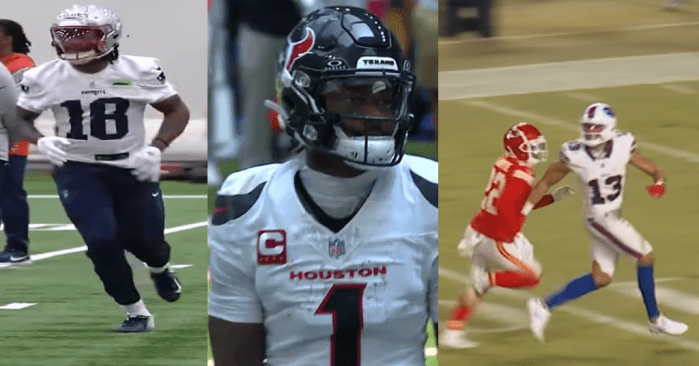
– It appears there’s a chance Stefon Diggs may be ready by Week 1. In his eight weeks on the field last season for the Texans before tearing his ACL, he operated in both 2-WR (Z) and 3-WR sets (slot). He tallied 47 catches during that spurt and finished the year 2nd among WRs in ESPN‘s receiver score metric. But Diggs will turn 32 in November. His age and recent injury suggest he’ll be a different player than in his prime years. Last year was the first time since 2016 where he was charted more in the slot (52.8%) than outside (45.1%), but he still played on the perimeter quite a bit, although some of his “outside” snaps were in Bobby Slowik’s Shanahan/McVay-esque condensed formations.

– There are several receivers who remained tough, higher-volume options well into their 30s, including Anquan Boldin, Steve Smith, Larry Fitzgerald and Julian Edelman. All of these receivers saw a significant increase in snaps in the slot as their career continued. Stefon Diggs was once a X-receiver, but there’s a prime opportunity here late in his career to occupy the high-volume hybrid Z/Slot role occupied by Julian Edelman and more recently, Jakobi Meyers. His inside-outside split could veer around 60:40 in either direction, but I expect Diggs to be a factor as a Z-recevier in 2-WR sets.

Kendrick Bourne and Kayshon Boutte could each have major roles come Week 1 or be off the roster entirely. There’s too much of a logjam here to make any promises. Bourne projects best as a fill-in for Diggs’ reps if the former Bills-Vikings receiver is unable to go Week 1. It’s not 1:1 fill-in, as I see Bourne as mostly a Z-receiver only in 2-WR and 3-WR sets as opposed to a high-volume slot-hybrid role. Bourne’s prime was sort of mismanaged in New England as I thought he had a chance to have a monster year in 2022 as both an inside and outside receiver after showing flashes in the McDaniels offense as a move-piece in 2021. Now, Bourne enters his age-30 season in a strange position considering the additions. I wonder if he’d be an option for a team like the Rams who lack a proven WR3. As for Boutte, he played admirably last year logging more snaps than any New England WR (760) as mostly a X-receiver. He had some moments, but his best role is likely a WR4-type snap count, maybe even as a Z-receiver who can work off the line, but often outside, where he’ll be given more space to operate as a YAC threat. I’m not sure I see a clear fit here in the McDaniels offense considering the state of this depth chart. It was already reported by Adam Schefter before the draft that Boutte may be available or “expendable.”

– DeMario Douglas was first among Patriots WRs in receptions last season (66), and was second on the team in targets (87) and receiving yards (621), behind tight end Hunter Henry. There’s a prime opportunity for him to take on a Danny Amendola or Hunter Renfrow-esque role as the team’s slot receiver in 11 personnel. Like Amendola and Renfrow, Douglas is best used as a slot-only option who plays 80% or more of his snaps inside. Although much more explosive than Amendola or Renfrow, Douglas lacks a bit of the route-running nuances (‘sit’ routes in zone coverage) needed for this role, and despite his speed, he’s still much too undersized (5-8, 192) to play Z-receiver snaps in 2-WR sets. One blocker for Douglas may be the eventual heavy usage of a hypothetical 3-WR set of Mack Hollins (X), Kendrick Bourne/Kyle Williams (Z) and Stefon Diggs (slot/Z) where Diggs almost fully occupies the slot role.

Ja’Lynn Polk‘s rookie campaign was a year he’d like to forget. The Patriots didn’t do him any favors with his usage as mostly a X-receiver (80% of snaps out wide) in a struggling offense with a patchwork offensive line. I think there is room for six WRs on this roster, and with the possible exodus with guys like Bourne and Boutte by Week 1, paired with his recent draft status as a second-round pick, I think it’s likely Polk is on the roster come Week 1. He deserves a shot to see how he fares in McDaniels’ offense. He has the profile of a stockier Jakobi Meyers-type who can play the Z and slot-receiver roles and win at the catch point (he has historically had great hands). He’ll likely need to work behind the scenes to earn playing time, and if not, I wonder if it’s best if he was traded in August to a Shanahan tree team where he’d be given the chance to revive his career in condensed formation looks and roles that I think would suit him well.

– Elsewhere, both Javon Baker and Efton Chism are noteworthy as receivers attempting to make the roster. Chism is a classic, McDaniels offense-style shifty slot receiver who moves really well. Baker has the potential to earn a spot as a rotational or depth option as a X-receiver considering the small amount of options on the roster, but he has an uphill battle.

Drake Maye + Jayden Daniels

Brent Schwartz’s 2024 NFL Mock Draft

We’re almost there. Two more weeks from today, this year’s top NFL Draft prospects will hear their names called in Detroit.

Each draft comes with its storylines and hype, but it’s not a stretch to say this is one of the four or five most exciting draft classes of the 21st century. (Unless that’s just the Patriots fandom in me talking?) Nevertheless, this draft is projected to go 1-2-3 with QBs, and possibly even 1-2-3-4 or four quarterbacks selected in the top five. Heck there’s even a shot we see six QBs selected in the top 13! This also feels like a historic class of wide receivers and offensive tackles. We could easily see nine offensive players selected with the first 10 picks, which is what I have below.

Well, let’s get started.

I’ll begin with deeper dives on the projected top QB placements, before using educated guesses and scheme knowledge/draft history to help project the entire first round of the draft and some fun Round 2 fits for teams.

Bears
              Caleb Williams             
 1. CALEB WILLIAMS
USC · QB
Williams enters the draft as arguably one of the four or five most touted quarterback draft prospects of the last 25-plus years. Since Peyton Manning, you could make the case that only Andrew Luck and Trevor Lawrence were more anticipated pro passers with a year-plus left in their collegiate careers.

Spare the off-the-field, debate-show semantics around Williams’ personality. Few prospects have ever been more tailored to their era than Williams entering the NFL now.

The 2022 Heisman winner has a rocket arm, a knack for playmaking  in and out of the pocket, and is superb in his off-platform throws and unique throwing angles. He’s Mahomes-ian in many ways — including his time spent under Kliff Kingsbury in college — and there’s possibly a dash of more on-the-move Aaron Rodgers ability to his game, as well.

Valid concerns include his hunting for big plays versus taking proper checkdown throws, as well as his projection from a college-style offense to a pro one. His 6-foot-1, 214-pound frame doesn’t bother me, as he has a stouter/muscular build that is halfway Jalen Hurts-ian (and maybe more Mahomes, again). He should be able to take the hits. Chicago fans should be excited for this new era.


Commanders
              Jayden Daniels             
 2. JAYDEN DANIELS
LSU · QB
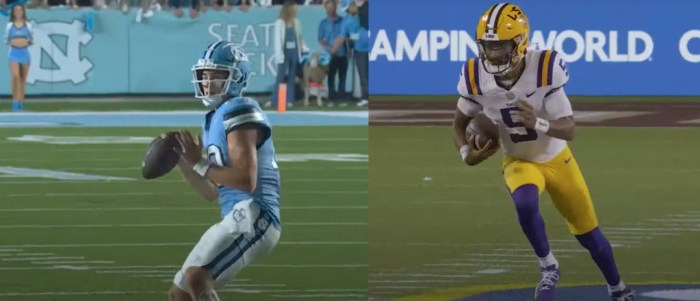
Things immediately get a bit tricky/educated guess-y with pick No. 2. No know truly knows if Washington prefers Jayden Daniels or Drake Maye. I lean with the Commanders taking the LSU QB here.

No player skyrocketed up draft boards during the 2023 college football season quite like Daniels. His eye-popping numbers earned him a Heisman trophy in December, and now many are wondering how his game will translate to the pros.

His slender frame (6-4, 210 lbs) and Evel Knievel-ish running style are somewhat concerning, but Daniels’ straight-line speed, throwing mechanics and passing accuracy are a delightful combination.

Even if you take away his speed, he looks like a natural thrower in the pocket, especially throwing outside the numbers. He has a beautiful touch and lightning-quick release. His arm strength is adequate for the pro game, but his tuck-and-run ability seems too frequent and impatient for the NFL level. There’s not many throw-on-the-run reps on film. He either throws in-pocket or moves off his progression and runs. His college scramble rate on non-pressured dropbacks (9.4%) was higher than Justin Fields’ mark (8%) and much higher than Caleb Williams (3%). (h/t @fball_insights).

Ultimately, new Commanders offensive coordinator Kliff Kingsbury is one of the more qualified teachers when it comes to ushering in a unique prospect like Daniels to the pros. Daniels should spend almost all of his time in shotgun in Washington. He’s not a dual threat QB who thrives on designed rushes. He doesn’t move laterally like Lamar Jackson, nor does he sport the Ravens QB’s quickness. Daniels also lacks the frame to pull off Cam Newton-esque ‘QB power’ concepts or Jalen Hurts-like zone-read reps. Daniels is more of a scrambler. He’ll need to adapt to NFL-level middle-of-the-field reads, but there’s great ability in him if activated. It’ll be fascinating to witness.


Patriots
              Drake Maye             
 3. DRAKE MAYE
UNC · QB
The Patriots will surely receive trade offers from teams like the Vikings and Giants for this pick, especially if Maye is available, but there’s no predicting the future when it comes to QB talent and draft positioning in 2025. Despite fielding a borderline expansion-level offensive roster pre-draft, the Jerod Mayo/Eliot Wolf-era truly begins with the selection of Drake Maye here.

Maye is your classic “built in a lab” QB prospect with ideal size (6-4, 223 lbs) and arm talent. He struggled some in his final college season at North Carolina, but his supporting cast wasn’t all that great.

Maye processes and lasers in NFL-level middle-of-the-field throws better than anyone in this class, and he has the athletic ability and playmaking traits to thrive off-script. However, he has an elongated throwing motion and tends to drift in the pocket, often throwing without his feet set. There’s some electric off-platform throws mixed in with some off-the-mark, inaccurate darts. There’s mechanical issues that will need some work, and he’ll need to develop more ball placement consistency.

OC Alex Van Pelt and former Giants head coach Ben McAdoo lead the new brass of Patriots quarterback development. Van Pelt puts a great deal of stock into footwork and mechanics when it come to passing.

Maye, along with Williams and Daniels, spent over 90 percent of his college snaps in shotgun, according to TruMedia, which isn’t a rarity for college ball. Maye has more work in pistol formations, where the QB turns his back to the defense on play-action throws. That’s a start, but the Patriots coaching staff will be tasked with teaching Maye how to thrive on under-center play-action concepts we can probably expect from a Van Pelt offense on early downs.

But the talent is obviously there. Maye leads all college quarterbacks since 2022 in two key PFF metrics: big-time throws (79) and passing grade (96.7).

If picks 2 and 3 do go this way, I think this: Washington is a much better scheme fit for Jayden Daniels than New England. And although Drake Maye could fit in any system (Shanahan-style, Josh McDaniels, Air Raid, etc.), he’s certainly the best fit for the Patriots, from New England’s perspective.

Unlike QB-needy teams who have a plan in motion and roster in place to compete (think: Minnesota), New England needs far more than a run-of-the-mill first-round QB prospect. They essentially need a quarterback “Messiah,” and after Williams, Maye best fits that mold. New England should be happy to take the Tar Heel here.


Cardinals
              Marvin Harrison Jr.             
 4. MARVIN HARRISON JR.
Ohio St · WR
This should be an easy selection for Cardinals GM Monti Ossenfort.

Son of Peyton Manning’s favorite target, Marvin’s skillset transcend that of just a Hall-of-Fame wide receiver’s kid. He’s lauded as one of the best receiver prospects of all-time. In terms of pre-draft hype, he seems firmly in the Larry Fitzgerald-Calvin Johnson-Ja’Marr Chase pantheon.

The 6-foot-3, 209-pound Harrison is a route-runners delight, drawing warranted comparisons to Davante Adams as a taller receiver with incredible smoothness and polish as a quick-footed separator. Because of that, he can move around the formation as both a perimeter and slot option, despite playing 84% of his Ohio State snaps on the boundary.

Harrison gives Kyler Murray a top-flight receiving option, and helps establish a pass-catching pecking order that continues with promising tight end Trey McBride and sure-handed possession receiver Michael Wilson.


Vikings
              J.J. McCarthy             
 5. J.J. MCCARTHY
Michigan · QB
TRADE! Minnesota unloads picks No. 11 and No. 23 and a few mid-round selections to move up to No. 5 for the Michigan QB.

Many will point to McCarthy’s not-asked-to-do-much resume at Michigan, but I’d argue his throw-on-the-run and crunch-time reps are pretty impressive on tape.

The National Championship-winning QB is a bit of a projection, but to me, he’s certainly worthy a first-round selection if you’re running a more-established Shanahan/McVay-style offense.

Minnesota already has the weapons (Justin Jefferson, Jordan Addison, T.J. Hockenson) and bridge QB (Sam Darnold) to help ease McCarthy into the league.

With time, he could turn into a menace on under-center, play-action bootleg reps. This could be an odd comp if you can’t see it, but to me he’s a college basketball-esque, senior point guard distributor. He’s a great athlete with ample size (6-2, 219 lbs). His potential is that of a new-age version of a classic/vintage west-coast passer with middle-of-field accuracy and intangibles that eventually could help the Vikings get back to winning close games (11-0 in one-score games in 2022).


Giants
              Malik Nabers             
 6. MALIK NABERS
LSU · WR
With quarterbacks flying off the board, the Giants go with the explosive, jet pack-charged Nabers here to elevate a depleted receiving core.

Nine out of 10 drafts, Nabers would be a surefire WR1. Nabers has absurd speed and YAC ability for his size (6-0, 200lbs). PFF graded him first among his draft class peers in just about every WR metric — grades on receiving, vs. man coverage, vs. zone coverage, in the slot.

He can line up anywhere (54% of college snaps in slot, 46% on outside). He’s drawn comps to former LSU star Odell Beckham Jr. That fits the bill to me, but he has more quick-slant-to-the-house potential and less catch-point ability.

Nabers would help set the target order for QB Daniel Jones, who has Darius Slayton, vertical threat (only) Jalin Hyatt, gadgety Wan’Dale Robinson and tight end Darren Waller at the top of the pass-catching totem pole right now.


Titans
              Joe Alt             
 7. JOE ALT
Notre Dame · OT
Pretty easy selection here I think if Tennessee stays put. The QB/WR superstars at the top of the draft have overshadowed what many believe is a future All-Pro left tackle in Joe Alt.

Alt is a massive presence (6-9, 321 lbs) with combine metrics worthy of one of the best draft prospects at his position, ever. Coming over from San Francisco, Titans GM Ran Carthon gets his Trent Williams here to help usher in the Will Levis-era, even if Williams and Alt are different prospects. New Tennessee head coach Brian Callahan and father Bill (OL coach; former Raiders head coach) will be happy with this.


Jets
              Rome Odunze             
 8. ROME ODUNZE
UW · WR
TRADE! With the Bears in play for Odunze and the possibility of the Bills making a Julio Jones trade-equivalent move up here, the Jets jump up two spots to ensure they snag an alpha-male WR prospect.

Similar to what I wrote in the Nabers selection, Odunze would probably be a WR1 in most drafts.

He’s more polished than Malik Nabers, with similar ball skills and catch-point ability as DeAndre Hopkins, but with better size (6-3, 212 lbs), speed, strentgth/physicality and yards-after-catch/contact potential.

The Jets patched up the offensive line in free agency and now can pair Odunze with Garrett Wilson, giving Aaron Rodgers one of the nastier X-Z receiver combos in pro football.


Bears
              Brock Bowers             
 9. BROCK BOWERS
Georgia · TE
Between Rome Odunze and Brock Bowers, the Bears and Jets will probably be in play for both prospects around this area of draft night.

New Bears OC Shane Waldron was a 12 personnel-heavy play-caller in Seattle before the Seahawks drafted slot receiver Jaxon Smith-Ngiba last spring. With D.J. Moore and Keenan Allen in the fold for Caleb Williams, the Bears blur the line between 11 and 12 personnel looks by complimenting traditional ‘Y’ tight end Cole Kmet with Bowers.

The Georgia product is one of the top five non-QB prospects in this draft in my opinion. Chicago can move the 6-3, 243-pound playmaker around the formation, but I see him best used as a slot playmaker who maybe lines up in Dalton Kincaid-ish spots, but has George Kittle-like ability.


Falcons
              Dallas Turner             
 10. DALLAS TURNER
Alabama · EDGE
Atlanta moves back two spots and still gets Dallas Turner to help optimize a pass rush that struggled last season.

New Falcons defensive coordinator Jimmy Lake plans to run a base 3-4 defense, where Turner will slot in at either stand-up EDGE spot. The 6-3, 247-pound Alabama product has deviant bend in his pass-rush moves, and coming from a Nick Saban defense, you know he can set the edge in the run game. Atlanta needs this level of athleticism and physicality on the edge. They get it here.


Chargers
              Taliese Fuaga             
 11. TALIESE FUAGA
Oregon St · OT
The Chargers swap places with the Broncos and land a made-for-Jim Harbaugh mauler at right tackle to compliment Rashawn Slater on the left side, and to help begin the franchise’s transformation into a tough-in-the-trenches squad.

Some project Fuaga better as a guard, but he has the size (6-6, 324 lbs) and potential as a pass blocker and should adjust to pro edge rushers over time. As a run blocker, he should enter the league as a powerful force from Day 1. Operation “keep Justin Herbert upright and make his life easier with a running game” begins now.


Broncos
              Laiatu Latu             
 12. LAIATU LATU
UCLA · EDGE
Many have Bo Nix and/or Michael Penix Jr. going at picks 12 and 13 to Denver and Las Vegas, but I think they each get their name called later.

As a pure pass rusher, I like Latu more than I do the more-complete Dallas Turner. He’s extremely skilled and polished working his way to the QB.

Denver defensive coordinator Vance Joseph needs a winner on the edge for his 3-4 scheme, and Latu provides that.


Raiders
              JC Latham             
 13. J.C. LATHAM
Alabama · OT
Vegas lands a massive right tackle here in Latham (6-6, 342 lbs) to pair with Kolton Miller on the left side.

The Raiders need some work on the right side of their offensive line, so this helps set a foundation for them in the trenches.

The ‘Bama product offers potentially-dominant ability in the run game as a “throw ’em out the club” people mover, and he has the quickness and foot work to pick things up quickly in pass protection.


Saints
              Olumuyiwa Fashanu             
 14. OLU FASHANU
Penn State · OT
This seems like a steal for the Saints if Fashanu falls this far. The Penn State left tackle was seen as a top-five player in this class by some earlier in the scouting process.

Labeling him “raw” is doing a disservice to the skills he’s already shown on film, but there will be a learning curve.

2022 first-round pick Trevor Penning has struggled at left tackle and right tackle Ryan Ramczyk may not play again. Fashanu would slot in at either spot.

Colts
              Quinyon Mitchell             
 15. QUINYON MITCHELL
Toledo · CB
Mitchell backs up an impressive Senior Bowl and combine showing by being the first cornerback off the board.

He has exceptional athleticism, explosiveness and ball skills. The Colts played more Cover-3 than any other team last season under defensive coordinator Gus Bradley. Mitchell should fit in well on the outside, with the ability to play man coverage on third down.


Seahawks
              Troy Fautanu             
 16. TROY FAUTANU
UW · OL
This is probably one of the more common player-team predictions in mock drafts. I like the idea of Laiatu Latu playing stand-up EDGE in Mike Macdonald’s defensive scheme, but with the UCLA product off the board earlier, new Seahawks OC Ryan Grubb gets one of his Washington guys.

Despite lacking the preferred length for a NFL tackle, Fautanu could probably get away with it due to his talent and skillset. But first, he slots in to one of the Seahawks’ guard spots to help improve the offensive line.


Jaguars
              Terrion Arnold             
 17. TERRION ARNOLD
Alabama · CB
A top-tier cornerback prospect falls to No. 17 for the second consecutive draft (Christian Gonzalez to Patriots in ’23).

Wide receiver is certainly a need with Calvin Ridley now in Tennessee, but the Jaguars get one of this draft’s top defensive players here.

Whether a zone-heavy or man-based coverage scheme, Arnold slots just about anywhere as a boundary or slot option. He’s feisty when attacking the ball, and should help a Jacksonville defense that struggled down the stretch in 2023.


Bengals
              Brian Thomas Jr.             
 18. BRIAN THOMAS JR.
LSU · WR
My hunch is the Bengals work out a trade for Tee Higgins (second-round pick and change?) during the draft, which allows them to go with an uber-talented vertical receiving threat on the perimeter here.

Thomas (6-3, 209 lbs) has a similar frame as Higgins (6-4, 219 lbs). He’s less of a jump-ball winner as the receiver he’ll replace, but Thomas is a more explosive threat (4.34 speed) with better route-running fluidity.

With Trent Brown in the fold to handle right tackle duties, Cincinnati can pass on an offensive tackle here and reach for rookie-contract upside in the receiving core with Higgins and Tyler Boyd out the door.


Rams
              Byron Murphy II             
 19. BYRON MURPHY II
Texas · DL
This not strictly a draft-for-need choice for the Aaron Donald-less Rams. Murphy is a quick, explosive interior disruptor with some of the same pre-draft size concerns (6-0, 297 lbs) as Donald.

The Rams began shifting away from 3-4 looks to more four-down fronts in 2023. But Murphy has some good 5-tech rep on film from Texas, if he is to fill in there in Raheem Morris’ 3-3-5 fronts.


Steelers
              Amarius Mims             
 20. AMARIUS MIMS
Georgia · OT
Mims has only eight collegiate starts at tackle. But even with the small amount of reps on film, his dominance shows out.

Let’s cut to the chase — he is GARGANTUAN. Standing at 6-foot-8 and weighing 340 pounds, he packs obvious power and surprising nimbleness. He doesn’t appear raw when looking at this Georgia tape.

I wouldn’t be surprised if he goes off the board in the early teens (Vegas?), but here the Steelers are able to move Mims’ former Bulldog teammate, Broderick Jones, to left tackle. Mims slots in nicely on the right side, and between the tackle duo, and former Georgia tight end Darnell Washington, good luck trying to play run defense versus that downhill stampede.


Dolphins
              Graham Barton             
 21. GRAHAM BARTON
Duke · OL
Barton played the majority of his time at left tackle at Duke, but he began his college career as a center.

Barton has the versatility to slot in at center or either guard spot with Miami barren at the position after losing Robert Hunt in free agency.

The Duke product is very quick for his size (6-5, 315 lbs) and should fit in nicely moving in space in Miami’s outside-zone heavy rushing scheme.


Eagles
              Cooper DeJean             
 22. COOPER DEJEAN
Iowa · DB
The Eagles’ Achilles heel on defense last season was the subpar play and deterioration of the linebacking core and secondary. With Vic Fangio in town as defensive coordinator, Philly selects one of the draft’s most versatile athletes.

DeJean is a ball skills aficionado with both basketball-level athleticism and the toughness to tackle in the run game.

With C.J. Gardner-Johnson back in town to handle nickel duties, Philly can opt to use DeJean at boundary cornerback, or move him around to emphasize his ability to play safety and in the slot.


Chargers
              Adonai Mitchell             
 23. ADONAI MITCHELL
Texas · WR
Harbaugh and Chargers GM Joe Hortiz almost begrudgingly take a talented receiver here before the second run begins.

I think even they know that they just can’t operate by leaving the receiving core as barren as is. After landing an offensive tackle, they dip into the well for a X-receiver with size (6-2, 205 lbs), speed (4.34), and superb body control. He’s a nuanced and polished route-runner who comes in ready to be Justin Herbert’s top target. Harbaugh can put his A.J. Jenkins-PTSD behind him here to give Herbert some help.


Cowboys
              Tyler Guyton             
 24. TYLER GUYTON
Oklahoma · OT
Dallas lost long-time bookend left tackle Tyron Smith and center Tyler Biadasz this offseason. Oregon center Jackson-Powers Johnson could be the selection, but I have Dallas going with more potential upside here by selecting Guyton to play left tackle, allowing them to keep All-Pro Tyler Smith at left guard.

Guyton is a raw prospect, but he’s shown the ability to play well in space in zone-rushing schemes, while also packing enough power to block defenders in gap-style runs like counter.


Packers
              Nate Wiggins             
 25. NATE WIGGINS
Clemson · CB
The Packers go back to the first-round cornerback well here considering their lukewarm return on Eric Stokes and odd behavior from Jaire Alexander.

Wiggins size is a bit of an issue (6-1, 173 lbs) but he uses his length to operate pretty well in press coverage. He also ran a 4.28 40 at the combine. The Packers take a chance on his athleticism, height and coverage smoothness here.

Buccaneers
              Jared Verse             
 26. JARED VERSE
FSU · EDGE
This could be a bit low for Verse, who projects better as a hand-in-the-dirt, athletic 4-3 defensive end who I initially liked for the Texans before their swap with the Vikings.

Here, Tampa makes it work with Verse at their 3-4 outside linebacker spot with Shaquil Barrett out the door. The Florida State product has the size (6-4, 254 lbs), burst and power to provide pass rush juice for a Bucs team that needs more from that spot despite investing a first-rounder in Joe Tryon-Shoyinka a few years back.


Chiefs
              Jordan Morgan             
 27. JORDAN MORGAN
Arizona · OT
TRADE! Even before the Rashee Rice situation, the Hollywood Brown addition was probably not enough to help improve Kansas City’s pass-catching core, but they also currently sit without a left tackle with Donovan Smith unsigned.

Morgan lacks the typical size of a NFL left tackle, and he’s better suited for an outside-zone rushing team like Miami than a inside, gap scheme Kansas City has gravitated to, but I’m betting Morgan’s quickness in pass protection to battle speed rushers catches Kansas City’s eye here.


Bills
              Xavier Worthy             
 28. XAVIER WORTHY
Texas · WR
With Stefon Diggs and Gabe Davis gone, Buffalo taps the new 40-yard dash combine record holder (4.21) as a Tyreek Hill emulator or ‘lite’ version.

Worthy is more than just a burner, and he has inside-outside versatility, but he’s nowhere near a Hill-level talent at the catch point.

Ladd McConkey was considered here as a less boom-or-bust, more polished route runner, but Buffalo can take a chance on a big play threat here with Allen’s gunslinger mentality and arm strength.


Lions
              Ennis Rakestraw Jr.             
 29. ENNIS RAKESTRAW  
Mizzou · CB
Even after adding Carlton Davis in free agency, the Lions add a boundary cornerback to a roster that doesn’t seem to have a glaring need.

Rakestraw has an auroa of energy and toughness and plays aggressively. He also takes on blockers while defending the run. He’s superb there. He’ll fit in perfectly with Dan Campbell’s Lions as a potential season-long growth project who could come up huge in January.


Ravens
              Darius Robinson             
 30. DARIUS ROBINSON
Mizzou · DL
This is a classic Ravens/Steelers/Belichick-era Patriots pick.

Robinson is a unique athlete in his positional versatility and size (6-5, 285 lbs). He reminds me somewhat of Keion White, New England’s second-round choice from last year,  in that he is sort of a “tweener” who can play all along the line.

He probably won’t spend too much time as a stand-up edge defender in Baltimore’s scheme, but he certainly can help fill the void left by Jadeveon Clowney as a strong-side edge setter in the run game. He played a ton of 5-tech snaps at Missouri, so I could see him playing a bit there, then kicking further inside on passing downs to rush the passer next to Justin Madubuike.


49ers
              Ladd McConkey             
 31. LADD MCCONKEY
Georgia · WR
I’m more confident in a Tee Higgins trade than I am San Francisco dealing Brandon Aiyuk or Deebo Samuel anytime soon. If the 49ers can swing a Deebo trade without too much dead cap left behind, South Carolina WR Xavier Legette makes some sense to replace Deebo’s YAC ability.

But here, the 49ers get one of the best route-runners in the class to either accentuate or eventually replace Aiyuk.

McConkey makes defenders look silly in man coverage, and he’s a borderline Tier 1-operator when it comes to the top of the route. He excels there at a level only Marvin Harrison Jr., Rome Odunze and A.D. Mitchell reside when it comes to this class.  I see McConkey thriving with Aiyuk’s in-breaker-heavy route tree, and he even works well as an at-the-snap motion piece here.

I’m sure San Francisco would love a replacement for Colton McKivitz at right tackle, but with their options limited at this stage of Day 1, they boost their league-best offense with one of my favorite prospects.


Cardinals
              Chop Robinson             
 32. CHOP ROBINSON
Penn St · EDGE
After moving back five spots in a trade with Kansas City, Arizona gets a twitchy edge rusher who could thrive in Jonathan Gannon’s defense with some development.

Robinson had a lot of hand-in-the-dirt pass-rushing snaps at Penn State, but he projects as more of a stand-up rusher in the pros. That bodes well in Arizona’s 3-4 defense. There’s a lot of boom-or-bust with this pick, but drafting talented development projects (he ran a 4.48 at 254 lbs) are sometimes what late-Round 1, early-Round 2 picks are for.

Round 2

Here are 15 fun Round 2 fits. I factored in team scheme into my projections.

Panthers
              Xavier Legette             
 33. XAVIER LEGETTE
SC · WR
Like the Patriots, the Panthers probably won’t fully solve their receiving core dilemma in this draft, but they can do their best to stock up on talent in a rich class at the position.

The South Carolina native and university grad stays close to home here with a team that reportedly wants him in the building.

Legette is one of favorite players in this entire draft. Whether it is his playing style or accent, he rocks as a prospect.

Only a few receivers in history have 4.3 speed weighing over 220 pounds. Legette is both A.J. Brown and DK Metcalf-ish with his size, speed and explosion. His RAS score is off the charts. But Legette projects as less of a pure X-receiver like Metcalf and more of a X/Z combo, or move piece who can thrive on crossers and with his YAC ability from condensed formations or different spots.

He can be a ball winner on fades and flies, but sticking him with a robust route tree right off the bat would likely be misusing his ability. If schemed right, he could be a difference maker right away for Carolina, a nice compliment to newcomer Diontae Johnson, who should handle the more diverse route tree.


Patriots
              Kingsley Suamataia             
 34. KINGSLEY SUAMATAIA
BYU · OT
I’d love a receiver here for the Patriots (they can also figure out a trade for Tee Higgins), but it feels like they may prefer tackle considering the drop-off soon after. There could be a heavier late-Day 1 run on tackles than even I envision here, which would force them to pivot to pass-catcher, but if Suamataia is available, I think New England jumps at the chance for a skillful prospect with size, nastiness and movement ability for their projected zone-rushing scheme.


Cardinals
              Jer'Zhan Newton             
 35. JER’ZHAN NEWTON
Illinois · DL
The Cardinals added Bilal Nichols, Justin Jones and the bulky Khyiris Tonga to their defensive line in free agency, but they could use a high-upside rookie here to further revamp in their makeover.

Newton is an undersized, but high-motor interior havoc-wrecker who would compliment some of the bigger bodies Arizona added in March.


Broncos
              Michael Penix Jr.             
 36. MICHAEL PENIX JR. 
UW · QB
TRADE! The Commanders have a wealth of premium picks, so selection No. 36 or 40 could be for sale for the right future assets. After failing to trade up for a Will Levis-esque trade with clubs at the very top of Round 2 who want to stick (Carolina, New England), Denver finally finds a suitor to jump Las Vegas (and perhaps Seattle?) here. Despite the Bo Nix-to-Denver projections, Penix become Sean Payton’s guy.

I like Penix’s culture fit with the Raiders as a tough/physical, comeback-from-injury story for Antonio Pierce’s rough-and-rowdy bunch, but Denver and New England are the most QB-needy teams in the draft, and Denver makes it known that Penix’s pocket presence, toughness and deep ball accuracy are something they covet.

The Washington QB has an odd arm delivery and will need to target the middle of the field more than he did in college, but his intangibles and mental toughness are something sorely needed in Denver’s rebuild, even if he doesn’t become the long-term solution. Penix also surprised many at his Pro Day with a reported 40-yard dash time of 4.51. That bodes well for any concerns regarding his knees.


Chargers
              Roman Wilson             
 37. ROMAN WILSON
Michigan · WR
Two receivers for the Chargers in the Top 40 seems unfathomable considering Jim Harbaugh’s positional importance guidelines but this move makes a ton of sense. He gets “his guy” at the high-volume Z/slot role after nabbing Mitchell for his X spot in Round 1. The Chargers’ receiving core is decimated pre-draft, but here they replenish the targets left behind by Mike Williams and Keenan Allen.


Eagles
              Jackson Powers-Johnson             
 38. JACKSON POWERS-JOHNSON
Oregon · OL
TRADE! The Eagles have picks No. 50 and 53, along with four selections in Rounds 4 and 5, so they can figure out a package here to move up 12 spots for Powers-Johnson.

The Oregon center has great size (6-3, 328 lbs) for an interior blocker, and his hand work and ability to climb to the second level and move in space are excellent. He would flourish in the Eagles’ zone-read and inside zone looks.

Cam Jurgens started at right guard last year for Philly, and there’s the potential he was being groomed to take over for Jason Kelce at center. With Kelce’s retirement, the Eagles can go one of two ways with this selection by either putting Powers-Johnson at guard, or keeping Jurgens in place and putting the rookie at snapper.


Panthers
              Ja'Tavion Sanders             
 39. JA’TAVION SANDERS
Texas · TE
The Panthers keep adding to their pass-catching core with an immediate starting option at tight end in Sanders, even if the Texas product is more of a ‘F’ or ‘flex’ option at the position.

Sanders has terrific ball skills and YAC ability and his tape shows better speed than his combine 40 (4.69) suggests. Like Legette, he’d be another plug-and-play playmaker for Carolina as they do their best to infuse some explosiveness and talent in to the offense.


Falcons
              Ricky Pearsall             
 43. RICKY PEARSALL
Florida · WR
With Zac Robinson taking over OC duties for the Falcons, you can expect a McVay, 11 personnel-heavy offense in Atlanta.

Drake London is there as an ‘X’ and Darnell Mooney should also project to start in 3-WR sets, but I think Atlanta is still looking to add competition for its WR3 duties.

There’s a chance they utilize Kyle Pitts in a unique way, but as of now, newcomers Ray-Ray McCloud and Rondale Moore feel like depth and gadget options more than a WR3.

Pearsall played most of his time in the slot at Florida (80% of snaps), but he has top-of-the-line quickness, great route-running, elusive YAC ability, and is fantastic at the catch point. He can thrive on both option routes and vertical concepts, and he’s also a willing blocker.

He seems like a perfect fit in a Shanahan/McVay style offense, where he’ll run option routes in spread looks and showcase his craftiness in condensed formation concepts.


Raiders
              Kool-Aid McKinstry             
 44. KOOL-AID MCKINSTRY
Alabama · CB
Back-to-back Alabama selections to kick of the draft here for the Raiders, whose best cornerback on the roster right now is Patriots castoff Jack Jones.

McKinstry is a scheme-agnostic cornerback in terms of his fit. His high-IQ and dependable ability make him an immediate candidate to start on the outside.

He’d be a nice fit opposite Jack Jones, who is an uber-aggressive ball hawk.


Saints
              Bo Nix             
 45. BO NIX 
Oregon · QB
With ample talk of a Bo Nix-Sean Payton combination kicking off the Denver rebuild, Nix ends up with Payton’s old team here as the Saints take a shot at a post-Derek Carr option for whenever they can maneuver their way around the cap in 2025 to get him off the books.

Nix is a better athlete than given credit for, and he has ample arm strength and pretty good accuracy to be a distributor in an up-tempo, quick passing game.


Steelers
              Jermaine Burton             
 51. JERMAINE BURTON
Alabama · WR
The Steelers traded Dionte Johnson but added Van Jefferson and Quez Watkins this offseason. Pittsburgh is known for astutely drafting wide receivers, so they should absolutely reach into this class to upgrade their suddenly barren pass-catching group.

Burton is an underrated prospect because of the influx of WR talent. He’s a vertical threat/downfield ball winner in a different way than George Pickens, so he should compliment his former Georgia teammate (before Burton left for Alabama) here well.

In this scenario, Pickens would be the boundary-X, Jefferson would work inside as a route-running afficiando, and Burton would have the chance to become WR2 as an outside/vertical slot presence (he played 80% of snaps on perimeter in college).


Cowboys
              Payton Wilson             
 56. PAYTON WILSON
N.C. State · LB
The Cowboys released Leighton Vander Esch and signed DC Mike Zimmer’s old pal Eric Kendricks this offseason.

Kendricks used to be the best pass coverage LB in the NFL during Zimmer’s days as Minnesota’s head coach but those days are long gone. Dallas could use someone like Wilson here in the front seven.

The NC State product is an incredible athlete and instinctive playmaker who reminds many of Luke Keuchly. He has range and length (6-4) and ran a 4.43 40 at the combine. But the develuation of linebackers, Wilson’s injury history and age (24) likely make him a Day 2 pick. 

Wilson won the Butkus award for best linebacker in college football and also nabbed the Chuck Bednarik Award given to the nation’s best defensive player overall. Dallas should be ecstatic with the ACC Defensive Player of the Year and All-American here.


Ravens
              Christian Haynes             
 62. CHRISTIAN HAYNES
UConn · OG
The Ravens lost both guards this offseason. They may need to move up for Haynes, but either way I like the fit here. Baltimore gets a fiesty, quick-moving guard who has been comped to former-Patriot, current-Texan Shaq Mason.

He’s an excellent run blocker and finisher at the tail-end of plays. He’ll fit right in at Baltimore as a potential Day 1 starter.


49ers
              Roger Rosengarten             
 63. ROGER ROSENGARTEN
UW · OT
The 49ers give competition to right tackle Colton McKivitz here with Rosengarten, who was coached by former 49er/Bronco Ed McCaffrey (Christian McCaffrey’s dad) in high school, and blocked in mostly a zone-based scheme while at Washington.

He may not start right away, but he has the potential to be an upgrade at right tackle.


Chiefs
              Malachi Corley             
 64. MALACHI CORLEY
WKU · WR
If Rashee Rice is unavailable this season, the Chiefs are essentially left with soon-to-be-35-year-old Travis Kelce, Hollywood Brown and gadget options Mecole Hardmon and Skyy Moore as Patrick Mahomes’ top pass catchers.

Post-Tyreek Hill, Kansas City became a more YAC-oriented underneath throwing offense. What better option here than “The YAC King” to help potentially replace Rice’s snaps?

Rice filled a role first filled by JuJu Smith-Schuster as a tough/dependable option on sit routes, drags and crossers. Corley’s average depth of target in 2023 (6.1, according to PFF) and yards-after-catch (2,068 over past three seasons; most in FBS) numbers paint a picture of how he operates as a 5-foot-11, 215-pound bulldozer to defensive backs.

There’s some concern over his ability to run a more diverse route tree. Failure to do so would mean a risk of overlap with Hardmon’s skillset, but I think Corley has the chops to become a unique horizontal threat with attitude in this Chiefs offense.