Kyle Williams, Stefon Diggs and Mack Hollins

Sorting out the the 2025 New England Patriots WR Group
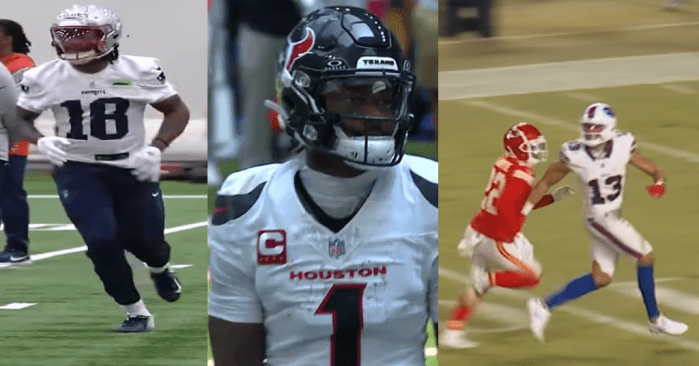
The New England Patriots will enter the 2025 season with a sense of renewed hope and optimism that has been absent over the past few years. In just the first offseason under new head coach Mike Vrabel, the roster has endured a rather dramatic makeover that has seen several additions and departures of long-time veterans and team captains.

With a young promising quarterback in Drake Maye, and Josh McDaniels returning for a third stint as offensive coordinator, things are expected to change, or rather, revert, to a familiar offense. The Patriots used their first three draft picks on the offensive side of the ball, and with mandatory minicamp soon approaching next month (June 9-11), focus will shift toward implementing McDaniels scheme, and the structuring of how the offense might look come Week 1 in early September.

To do that, the Patriots will need to figure out their wide receiver depth chart. At the moment, there is an unusual logjam at the receiver position. One could argue New England still lacks a top weapon, but between a bevy of returning members and newcomers, the team has around seven or eight receivers that project as 53-man roster options in many NFL teams’ five-receiver depth charts.

In figuring out where players may project within the offense, it’s best to start with what receiver roles may be present within the offense McDaniels is implementing for Maye and company.

Using charting data from PFF, I was able to glean three fairly distinct receiver alignment roles under Josh McDaniels during the three-season stretch from 2020 through 2022. This time included the final two years of McDaniels’s second offensive coordinator stint in New England (2020-2021), and his only full season as head coach of the Las Vegas Raiders (2022). These three seasons are not only McDaniels most recent campaigns as a full-time coach, but they’re also key in analyzing and projecting receiver roles, particularly in a post-Tom Brady McDaniels-led offense.

Role 1 (X-receiver)

Year/Team Player Snap % Wide Snap % Slot Snap % aDot (average depth of target in yards)
2020 Patriots Damiere Byrd 89% 91% 9% 12
2021 Patriots Nelson Agholor 64% 90% 10% 14.8
2021 Patriots N’Keal Harry 30% 87% 13% 14.8
2022 Raiders Mack Hollins 94% 86% 14% 13.1

– This was a fairly easy role to identify between charting data and sampled film watching. This is by and large a boundary X-receiver deployment and downfield/vertical role in both 2-WR sets and 3-WR sets, with little alignment versatility. And as opposed to the heavy usage of condensed formations in Kyle Shanahan/Sean McVay tree offenses, McDaniels typical uses wider spacing or formational width, with receivers in this role truly lining up out wide.

– Despite the X-role, none of the receivers above were top playmakers within their offense. There’s a diverse set of skills, body builds and player archetypes in this hodgepodge group. Damiere Byrd’s size for this role was an anomaly (5-9, 175 pounds), but he ran a 4.28 40 at his Pro Day. Mack Hollins carved out a boundary role in the 2022 Raiders offense, and has the requisite size (6-4, 221), but doesn’t necessarily have the explosiveness for the position.

– Nelson Agholor’s best season as a pro came in 2017 for the Super Bowl champion Philadelphia Eagles, where he spent 86.2% of snaps that season in the slot. After signing with the Patriots, New England used him on the outside for a career-high 90% percentage of snaps for a season. For reference, Agholor has spent 66% of his snaps in the slot in Baltimore over his last two seasons. Toward the end of the year, N’Keal Harry began cutting into his snaps at the position, which is reflected in his similar snap alignment and identical aDot metric.

Roles 2 & 3 (Alignment versatility, Z vs Slot, 2-WR set vs. 3-WR set roles)

Year/Team Player Snap % Wide Snap % Slot Snap % aDot (average depth of target in yards)
2020 Patriots N’Keal Harry 58% 63% 36% 8.4
2021 Patriots Kendrick Bourne 52% 62% 37% 8.5
2022 Raiders Davante Adams 95% 70% 30% 12.8
Year/Team Player Snap % Wide Snap % Slot Snap % aDot (average depth of target in yards)
2020 Patriots Jakobi Meyers 66% 40% 60% 10.6
2020 Patriots Julian Edelman 26% 25% 75% 10.9
2021 Patriots Jakobi Meyers 84% 34% 66% 9.8
2022 Raiders Hunter Renfrow 34% 14% 86% 6.5
2022 Raiders Keelan Cole Jr. 34% 37% 63% 17.3

– A McDaniels offense is known for operating from the inside out through its slot receivers and tight ends. There’s essentially two different roles here – one with 60-70% of snaps spent outside, and the other with 60-70% of snaps in the slot. Things get a bit too complicated to identify these roles as just ‘Z’ receiver and slot. And there’s some overlap in the above examples on which style of receiver (in terms of deployment/charting data) is used in 2-WR sets.

– We’ll start with Davante Adams, who was still an elite receiver in 2022 in Las Vegas. No receiver in this data or on the current Patriots roster is even close to the level of Adams in 2022, who led the NFL in receiving TDs (14) with 1,516 receiving yards on a career-high 180 targets. For context, in that same 2022 season, Jakobi Meyers led the Patriots with 96 targets. McDaniels deployment of Adams is notable and worth revisiting if the Patriots add a top-flight WR1 in 2026 or beyond. Adams was moved all around the formation and used as a vertical threat in 2022, where he posted a career-high 12.8 aDot.

– The high-volume “WR1” role from a targets perspective has often been the hybrid Z/slot role under McDaniels in New England. This player is primarily a receiver who operates mostly inside on underneath to intermediate routes, both from the slot and off the line on the outside, where the player would often come in motion pre-snap. This receiver would be the flanker in 2-WR sets and often would play in the slot or as a Z-receiver in 3-WR sets or spread looks. Julian Edelman occupied that role for most of his career. Many often lump Edelman, Danny Amendola and Wes Welker as similar players, but remember, both Edelman and Amendola co-existed in the same McDaniels offense for years. Amendola (and Welker) spent over 80% of his career snaps in the slot. Edelman had a role in 2-WR sets and he spent a lesser 55% of his career snaps in the slot, but as he suffered an ACL tear and aged into his 30s, he began to spend more time inside.

– Edelman, then age 34, began the 2020 season as primarily a slot receiver with Cam Newton at the helm, working alongside Damiere Byrd (X) and N’Keal Harry (Z). After six games, Edelman went on IR and later retired that offseason. Between Edelman’s injury and Harry failing to carve out a role as a jumbo Z/move-receiver, Jakobi Meyers took the baton as the new top target. Meyers played more snaps than any other Patriots receiver from Week 8 on in 2020, and then paced the entire depth chart again in 2021 with Mac Jones at QB. He operated as both a slot receiver and as a flanker in two-WR sets. McDaniels eventually signed Meyers away from New England to Las Vegas in 2023.

– Elsewhere, Kendrick Bourne served as a Z-receiver in 2021 in New England in 3-WR sets, working in unison with Meyers as a more productive YAC target on screens, reverses and other designed targets, where as Meyers was given more of the focal routes on key third downs. In 2022 in Las Vegas, Hunter Renfrow worked as a static slot receiver in 3-WR sets, similar to Amendola, and Keelan Cole Jr. mixed in as a vertical slot option who could also play on the outside. Cole led the Raiders in aDOT (17.3) that season and there wasn’t much overlap between him and Renfrow being used on the field at the same time. Renfrow or Cole’s presence on the field probably helped dictate Adams’ pre-snap deployment to a degree that season.

Projecting Patriots 2025 WR Depth Chart

Here is where it gets fun. The first question I pondered with this assignment is – how different will this version of McDaniels offense look with Drake Maye? And after consideration, I really don’t expect the tentpoles of his offense to change that much. Even in his lone full season as Raiders head coach in 2022, which included the force-feeding of targets through the air to Davante Adams, McDaniels still found ample snaps for Josh Jacobs to lead the league in rushing yards (1,653) and gap run concepts (201), per PFF.

This season, I expect New England to either utilize a fullback or run 12 personnel (2-TE sets) to play smash mouth football, run power concepts with pulling guards, and feature play-action passing elements that mimic their gap runs. This means there will be an assortment of 2-WR packages, allowing the distinction of which receivers are worthy of playing in 2-WR sets vs operating in 3-WR sets and other spread looks. Still, like most modern offenses, there should be a heavy dose of 11 personnel groupings, and although I don’t expect the offense to take on any major changes from what Patriots fans are accustomed to, I imagine there will be an uptick of shotgun usage to compliment Maye’s experience and play style. New England may also implement packages and formations that feature zone-read, QB power or other designed QB run concepts like what was seen with Cam Newton at the helm in 2020.

But by and large, this should be a familiar offense. So which of the many receivers currently on the roster will be featured?

2-WR Sets
X  Kyle Williams  Mack Hollins  Javon Baker
Z  Stefon Diggs  Kendrick Bourne  Ja’Lynn Polk
3-WR Sets
X  Kyle Williams  Mack Hollins  Javon Baker
Z  Stefon Diggs  Kendrick Bourne  Kayshon Boutte
Slot  DeMario Douglas  Ja’Lynn Polk  Efton Chism

– History has not been kind to the Patriots this century when it comes to drafting WRs, but their selection of Kyle Williams in the third round last month drew heaping praise from the NFL Draft community. His blend of speed, downfield explosiveness, acceleration and YAC ability make him a three-level threat from multiple alignments. But even at his size (5-11, 190 lbs), Williams’ ability on tape in college at the X-receiver spot, paired with New England’s need at the position, set him up with a unique opportunity as a Day 2-drafted rookie.

– There’s some history with smaller X-receivers both at the All-Pro/Hall-of-Fame level (Antonio Brown), solid/near Pro Bowl level (Deion Branch) and serviceable level (see Damiere Byrd in 2020 referenced earlier). Branch in New England in 2002-2005 is a good example of how a smaller, shiftier X-receiver fares in an offense such as the one we’ll see this year. McDaniels took over play-calling duties from Charlie Weis in the Patriots Erhardt-Perkins style offense in 2005. Kyle Williams doesn’t quite possess the shiftiness and nuance of Branch then, but he packs more of an explosive punch as a potential vertical separator.

Kyle Williams spent 74% of his snaps out wide for Washington State last year, and per PFF, he led his draft class with 8.4 YAC per reception (min. 75 targets). According to PFF, Williams was also in the 85th percentile or better in YPPR (yards per route run) on go routes, on screens and on hitch routes in FBS play in 2024, and he was over the 90th percentile both versus man coverage and when lined up in the slot (26% of snaps). Those marks alone exhibit his diverse skill set. He has the ability to line up inside or off-the-line as a flanker, but by midseason, I project Williams to be the team’s top outside receiver in both 2-WR and 3-WR sets.

Mack Hollins made some big catches for Buffalo late last season, and his breakout year as a receiver was as a perimeter player for McDaniels in Las Vegas in 2022. But Hollins will turn 32 in September. There will be a need for more explosiveness at the position. As it stands, he has a solid chance of being New England’s Week 1 starting X-receiver, at least in 3-WR sets and red zone looks as a jump ball operator, while Williams gets acclimated. Hollins is also a willing and able blocker, experienced special teamer, and he brings a vibe of toughness that Vrabel is looking for. But if the offense is to be at its best, he will serve as more of a rotating X-receiver and in a WR4-type role as the season progresses.

– It appears there’s a chance Stefon Diggs may be ready by Week 1. In his eight weeks on the field last season for the Texans before tearing his ACL, he operated in both 2-WR (Z) and 3-WR sets (slot). He tallied 47 catches during that spurt and finished the year 2nd among WRs in ESPN‘s receiver score metric. But Diggs will turn 32 in November. His age and recent injury suggest he’ll be a different player than in his prime years. Last year was the first time since 2016 where he was charted more in the slot (52.8%) than outside (45.1%), but he still played on the perimeter quite a bit, although some of his “outside” snaps were in Bobby Slowik’s Shanahan/McVay-esque condensed formations.

– There are several receivers who remained tough, higher-volume options well into their 30s, including Anquan Boldin, Steve Smith, Larry Fitzgerald and Julian Edelman. All of these receivers saw a significant increase in snaps in the slot as their career continued. Stefon Diggs was once a X-receiver, but there’s a prime opportunity here late in his career to occupy the high-volume hybrid Z/Slot role occupied by Julian Edelman and more recently, Jakobi Meyers. His inside-outside split could veer around 60:40 in either direction, but I expect Diggs to be a factor as a Z-recevier in 2-WR sets.

Kendrick Bourne and Kayshon Boutte could each have major roles come Week 1 or be off the roster entirely. There’s too much of a logjam here to make any promises. Bourne projects best as a fill-in for Diggs’ reps if the former Bills-Vikings receiver is unable to go Week 1. It’s not 1:1 fill-in, as I see Bourne as mostly a Z-receiver only in 2-WR and 3-WR sets as opposed to a high-volume slot-hybrid role. Bourne’s prime was sort of mismanaged in New England as I thought he had a chance to have a monster year in 2022 as both an inside and outside receiver after showing flashes in the McDaniels offense as a move-piece in 2021. Now, Bourne enters his age-30 season in a strange position considering the additions. I wonder if he’d be an option for a team like the Rams who lack a proven WR3. As for Boutte, he played admirably last year logging more snaps than any New England WR (760) as mostly a X-receiver. He had some moments, but his best role is likely a WR4-type snap count, maybe even as a Z-receiver who can work off the line, but often outside, where he’ll be given more space to operate as a YAC threat. I’m not sure I see a clear fit here in the McDaniels offense considering the state of this depth chart. It was already reported by Adam Schefter before the draft that Boutte may be available or “expendable.”

– DeMario Douglas was first among Patriots WRs in receptions last season (66), and was second on the team in targets (87) and receiving yards (621), behind tight end Hunter Henry. There’s a prime opportunity for him to take on a Danny Amendola or Hunter Renfrow-esque role as the team’s slot receiver in 11 personnel. Like Amendola and Renfrow, Douglas is best used as a slot-only option who plays 80% or more of his snaps inside. Although much more explosive than Amendola or Renfrow, Douglas lacks a bit of the route-running nuances (‘sit’ routes in zone coverage) needed for this role, and despite his speed, he’s still much too undersized (5-8, 192) to play Z-receiver snaps in 2-WR sets. One blocker for Douglas may be the eventual heavy usage of a hypothetical 3-WR set of Mack Hollins (X), Kendrick Bourne/Kyle Williams (Z) and Stefon Diggs (slot/Z) where Diggs almost fully occupies the slot role.

Ja’Lynn Polk‘s rookie campaign was a year he’d like to forget. The Patriots didn’t do him any favors with his usage as mostly a X-receiver (80% of snaps out wide) in a struggling offense with a patchwork offensive line. I think there is room for six WRs on this roster, and with the possible exodus with guys like Bourne and Boutte by Week 1, paired with his recent draft status as a second-round pick, I think it’s likely Polk is on the roster come Week 1. He deserves a shot to see how he fares in McDaniels’ offense. He has the profile of a stockier Jakobi Meyers-type who can play the Z and slot-receiver roles and win at the catch point (he has historically had great hands). He’ll likely need to work behind the scenes to earn playing time, and if not, I wonder if it’s best if he was traded in August to a Shanahan tree team where he’d be given the chance to revive his career in condensed formation looks and roles that I think would suit him well.

– Elsewhere, both Javon Baker and Efton Chism are noteworthy as receivers attempting to make the roster. Chism is a classic, McDaniels offense-style shifty slot receiver who moves really well. Baker has the potential to earn a spot as a rotational or depth option as a X-receiver considering the small amount of options on the roster, but he has an uphill battle.

Mac Jones and Bill Belichick -- 2023 New England Patriots Training Camp

2023 New England Patriots Preview: Make or break season?

With the first full Sunday slate of NFL games in 2023 just a few days away, few teams (maybe none) feel like they’re at a crossroads moment as much as these New England Patriots.

It’s been three years since Tom Brady left what is still the 21st century’s most successful North American sports franchise. But as the fourth post-GOAT campaign kicks off — all while honoring Brady in their Week 1 game versus Philadelphia — that moniker of success is now slow-rolling away, transforming into a frozen moment of time; albeit 20 years worth.

Things have felt a bit stagnant the last few seasons as Belichick mixes and matches ideas and strategies, with nothing concrete in place when it comes to franchise direction other than the building of his new-age (sort of) defense. And really, that’s…OK.

Belichick shed light over the summer on how long it takes to build a team from scratch:

“You know, ’96 was a big year for me here in New England,” Belichick told The 33rd Team/Mike Tannenbaum.

“Developed a great relationship with Mr. (Robert) Kraft and other people in the organization. When the opportunity came in 2000, even though this team was nowhere near the team we left in ’96 — it had declined quite a bit — there were still some pillars here that we could build with.

“I would say that by ’03 — even though we won in ’01 — that this was a pretty, pretty good football team in all three phases of the game. It kind of took the same basic four-year window that it took in Cleveland. We were fortunate to win in ’01, but I would say by ’03, ’04 we had one of the better teams in the league.”

Belichick is right. Modern day NFL coverage (debate shows, social media, etc.) has turned the analysis of any sort of rebuild/multi-year team-building into a frenzy of mostly engagement-seeking headlines and hysterics.

When Brady left in 2019, the Patriots had become cap-strapped, with their mini-Saints/Rams-like handling of Brady’s contract toward the end playing a major factor. They had absolutely no cap space in 2020, a year in which they paid Cam Newton just $1 million-$2 million to start at QB. They also had an aging team with bottom-of-the-league talent at the skill positions, fielding Damiere Byrd as it’s top WR option on the outside. So let’s just say, 2020 shouldn’t really count toward the rebuild. It was more of a standalone “reset,” specifically with their cap situation.

But 2021 and 2022 do count.

I’m not going to bore you with Matt Patricia-to-Bill O’Brien analysis. We’ve been through six or seven months of that. But the wasted 2022 season did feel like a setback. And despite some success in 2021, the end of that year was pretty discouraging, as well.

So even the most patient and knowledgeable people in the NFL media space have to admit that bills are beginning to come due. We’re not exactly sure what needs to happen this season with Belichick and the Patriots, but we know it must be something that can be registered as a positive takeaway as the team heads into 2024. There needs to be some direction, or a clear vision, particularly on the offensive side of the ball.

To me, the biggest question and set of sub-questions with this Patriots organization at current is— where do they fit in in an era that Andy Reid, Patrick Mahomes and the Kansas City Chiefs define as much as Belichick, Brady and the Patriots did in the 2000s and 2010s? Will they eventually be challengers? How do they get there?

Where does New England fit in an era of: the mobile quarterback, Shanahan offenses, speed over power at the skill position, lighter defensive boxes and front seven defenders, one-gap (or “gap and a half“) defensive lineman over old-school, big-ass two-gappers?

My take: even with the changes in today’s game, Belichick can be counted on to build a successful defense. But on offense, we should be in wait-and-see mode.

Publicly, Robert and Jonathan Kraft have voiced that a season like last year is unacceptable, while also toeing the line enough in praise of Belichick, his methods, and his job secruity. As Belichick approaches Don Shula’s all-time wins record (18 wins away; including playoffs), my guess is Belichick has a longer leash than public perception. But make no mistake, a ghastly 2023 season could mean the end. But I don’t see that happening.

Now, let’s get to the fun stuff.

*******

Week 1 Projected offense:

QB — Mac Jones

RB — Rhamondre Stevenson 

X’ WR — Devante Parker

‘Z’ WR — Kendrick Bourne

‘Power’ Slot — JuJu Smith-Schuster

‘Y’/Traditional TE — Hunter Henry

LT — Trent Brown 

LG — Cole Strange 

C — David Andrews 

RG — Michael Onwenu

RT — Calvin Anderson/Sidy Sow

Situational positions: 

Early-down rotational RB — Ezekiel Elliott

‘Big Slot’/F-TE — Mike Gesicki

“Jitterbug” Slot  — Demario Douglas 

‘X’ WR/”Speed”/downfield Slot  — Tyquan Thornton

‘X’ WR/’Z’ WR — Kayshon Boutte

Top backup Guard — Atonio Mafi

* * * * * * *

🏈 With a fifth-year option decision looming for the Patriots on Mac Jones in May, and a dynamite-looking QB draft class upcoming, Year 3 seems like the deciding season for Jones’ Patriots future. His sophomore slump can mostly be chalked up to the coaching/scheme disaster, but there’s real, there’s warranted concern over Jones’ ability to throw under pressure/against the blitz versus an NFL pass rush. He was 42nd among QBs in passer rating versus five or more rushers (70.7) last season, according to Sports Info Solutions. He also ranked 43rd out of 43 qualifying QBs in percentage of passes versus five or more rushers that resulted in positive EPA (28.4%). Still, it’s no surprise that all of Jones’ stats and efficiency metrics were way down last year. The Bailey Zappe “battle” for the starting job was always a silly story. Zappe doesn’t have the NFL ready-traits or arm that Jones has, but Zappe did seem a bit more comfortable in traditional Patriots/Brady shotgun-spread,”survey the field” point guard/distributor snaps. I think there’s something to be said for how Jones’ college experience translates to the pros, or at least, under Belichick in a traditional Patriots offense. The good news is, there’s no one more qualified than Bill O’Brien when it comes to making Jones more comfortable with the teachings of traditional Patriots concepts fused with Alabama/college-level designs. Under-center play-action passing, RPOs (and not the freshman-level bubble screens from last year) and shotgun, five-wide matchup hunting (Hoss Y Juke, etc.) are all on the menu. The hope is Jones fits two seasons of progression/improvement into 2023, putting him back on a normal progression path heading into 2024/Year 4. It may be a lot to ask, but it’s possible.

🏈 Rhamondre Stevenson, nicknamed “Franchise,”  is the most exciting skill-position player the Patriots have. He’s an anomaly as a larger back (6-0, 227 lbs) with the ball carrier vision, quickness and make-you-miss ability of a smaller back. After Stevenson, the Patriots are mostly trotting out a RB-WR-TE group that falls somewhere between “what a great 2018 skill position group!” jokes and “this is definitely enough to keep pace with other offenses.” But there is reason for optimisim with the addition of Ezekiel Elliott, even if with his declining play in Dallas. Elliott can still spell Stevenson as a between-the-tackles, early-down rusher and as an occasional pick-up-the-blitz blocker on third-down passing situations. Stevenson was clearly gassed at the end of last season, and the 2022 draft class duo of Pierre Strong Jr. and Kevin Harris was not enough on the depth chart. Strong, for one, was clearly drafted with the ham-handed idea of implementing an outside/wide zone running game already in mind for 2022, an endeavor that they abandoned pretty early on last season. Under O’Brien, expect a mix of gap-scheme power runs and shotgun inside-zone looks. Stevenson and Elliott should thrive there. The only possible issue is the effectiveness of classic Patriots power runs without a fullback on the roster.

🏈 At tight end, the Patriots subbed out Jonnu Smith for Mike Gesicki. New England never knew what to do with Smith, who should fit perfectly right back into Arthur Smith’s offense in Atlanta as an off-the-line/H-Back type in their zone-running/play-action scheme. Gesicki is purely a “big” slot receiver as opposed to a ‘Y’ tight end, like Hunter Henry. So like rookie receiving tight end Dalton Kincaid in Buffalo, the line between 11 and 12 personnel is blurred with Gesicki on the field as an athletic seam-stretcher and red zone threat. Still, I expect the Patriots to operate mostly with three pure wide receivers as their ‘base’ offense, as opposed to a Gesicki-Hunter Henry, “11.5” personnel group as a snap-hogging unit. I don’t think the Henry-Smith disappointment has necessarily given the Patriots extreme pause on high usage of Gesicki and Henry on the field at the same time at a high rate, but they know this is not a dynamic, Rob Gronkowski-Aaron Hernandez duo, or a “twin towers” Y-TE tag team that they briefly fielded with Gronk and Martellus Bennett. Gesicki is not an in-line blocker, and even Henry is not the best blocking tight end. Gesicki’s intial presence could come the way of red zone snaps with Henry, where he can open things up for a struggling red zone offense, as well as spelling Henry on some third-and-long snaps as a field stretcher on clear passing downs.

🏈 Elsewhere in the receiving core, New England added former Chiefs Super Bowl hero JuJu Smith-Schuster in place of Jakobi Meyers, and picked up two receivers in the 6th round that both made the 53-man roster in Kayshon Boutte and Demario Douglas. Losing Meyers hurts. The former NC State QB-turned-WR did everything right, and has developed into one of the league’s better route runners as well as sure-handed possession guys. But in New England, the high-volume Z/slot role needs to be an explosive, yards-aftert-catch option, and despite some impressive jump balls and top-of-route moves at 6-2, 200 pounds, Meyers has been one of the worst YAC players in football, with his YAC EPA over expected per catch since 2021 (-0.26) registering dead last in the league. In Smith-Schuster, New England now has last season’s fourth-best YAC per reception (min 50 REC) receiver from last year, with his 6.4 YAC per REC number below just Deebo Samuel, Jaylen Waddle and A.J. Brown. Smith-Schuster had roughly a 60-40 boundary-slot snap split with KC last year, thriving on perimeter sit routes and Malcolm Mitchell Super Bowl 51-esque comeback patterns, as well as RPO slants and deep crossers both off-the-line in bunch/stack looks and on-the-line from the slot and peremiter. I expect JuJu to play much more in the slot than boundary in New England, where O-Brien will look to utilize him underneath as a bully-ball YAC weapon at 6-1, 215 lbs. New England’s ‘X-WR’ option is again DeVante Parker. Parker (6-3, 215 pounds) generates almost no separation but makes up for it by being one of the best jump-ball/contested catch players in football. Of players with at least 34 receptions last season, or deemed as “starters,” Parker finished first in average depth of target (15.9 aDOT), just ahead of fellow X-receivers like Gabriel Davis, D.J. Chark and George Pickens.

🏈 Parker and Smith-Schuster are capable, but the Patriots need receivers who can separate. Tyquan Thornton is beginning the season on IR (can return after 4 games), and with New England’s sketchy draft history at the position, it’s worth wondering if Thornton may only be a WR 4/5 option as a designed deep-shot target a la 2003 2nd-round pick WR Bethel Johnson. The rookies show some promise, with Boutte providing some gritty YAC ability and inside-outside versatility, but he’s not yet a starting option. Demario Douglas is much closer as a “jitterbug” slot option the Patriots usually covet. Douglas packed on muscle over the summer to get to 5-8, 192 pounds. He has speed and quickness. His route tree and movement skills resemble sort of cross between some early-mid 2000s Deion Branch and Julian Edelman. Although, I don’t think Douglas can get to the third level like Branch. He’s not a deep option. The Patriots have largely kept Douglas under wraps in the preseason. I’d temper expectations on Douglas being an immediate boost to the offense, but there is promise. New England’s X-factor in the WR core happens to be Kendrick Bourne. He was in the dog house last year, but put up a mighty efficient 2021 campaign. He’s the most versatile inside-outside option they have. Even dating back to his San Francisco days, he was a tough, clutch possession guy on 3rd-and-9’s or so for Jimmy Garoppolo. He’s become more dynamic in New England, thriving more after the catch, on deeper routes, and with creating more separation. It’s a concern that he may be their best separator, but Bourne is definitely a damn good receiver. He projects as the starting ‘Z’ receiver in 11 personnel with Parker (X) and Smith-Schuster (‘power’ slot).

🏈 The offensive line easily slots in as the most concerning on offense. This could be their achilles heel. But when healthy, New England should have four of their five spots figured out, which isn’t bad. Trent Brown is aging but still a solid left tackle. The same with David Andrews and his leadership/skills at center. At guard, Cole Strange and Michael Onwenu could vault into a Top-5 duo, but each enter Week 1 banged up. Onwenu is one of the best gap-scheme mauling blockers in the league. Last year’s push to outside zone running didn’t cater to his strengths. Strange, on the other hand, would slot in nicely to such a scheme, but he has the toughness and technique to thrive in power looks, as well as pass blocking. If neither can go, or if New England plans to move Onwenu back to right tackle, fifth-round rookie Atonio Mafi from UCLA would step in. Mafi (6-3, 330 pounds) is a power-running blocker in the mold of Onwenu. He could eventually be Onwenu’s replacement if the latter maxes out of New England in free agency this offseason. The big question mark up front is at right tackle, where Calvin Anderson projects as the starter Week 1, if he can go. If not, rookie converted-guard Sidy Sow likely slots in over recent trade options Tyrone Wheatley Jr. and Vederian Lowe. There’s a chance Anderson becomes another iteration of 2018 Trent Brown in New England as a mostly unproven player with promise. Stories like that were common with former offensive line coach Dante Scarnecchia. New offensive line coach Adrian Klemm, Belichick’s first ever draft pick as New England’s head coach, was brought in to fix things up front. He’ll be relied upon heavily in the early going to coach up whoever mans the right tackle spot.

*******

Week 1 Projected defense:

Interior/Nose Tackle — Davon Godchaux

Interior— Lawrence Guy

Interior/EDGE — Deatrich Wise Jr. 

EDGE (stand-up) — Matt Judon

Off-ball LB/Thumper — Ja’Whaun Bentley

Safety/LB (box) — Jabrill Peppers

CB1 (boundary/cover marquee ‘X’ receivers) — Christian Gonzalez

CB2/Slot CB (field/cover ‘Z’ and marquee slot receivers) — Jonathan Jones

STAR/Nickel (man-covering TEs) — Jalen Mills

Safety (Roaming/Robber/Box) — Kyle Dugger

Safety (Deep) — Adrian Phillips 

Situational positions:

Interior/Nickel + Dime — Christian Barmore

EDGE/Nickel + Dime pass rusher (passing downs) — Josh Uche 

EDGE (stand-up and hand-in-dirt)/Interior — Keion White

Off-ball LB/Dime Back — Marte Mapu

CB3/Boundary CB — Jack Jones

CB4 (Boundary + Slot) — Marcus Jones

‘Big’ Slot CB (Man-covering TEs) — Shaun Wade

Safety (Quarter/Zone-coverage) – Myles Bryant

EDGE (early down, edge setting, depth/rotational) — Anfernee Jennings

Off-ball LB (depth/rotational) — Mack Wilson Sr. 

3-4 interior (depth/rotational) — Sam Roberts

* * * * * * *

🏈 Per usual, expect the Patriots to be multiple on defense, stressing odd 3-4 looks or 3-3-5/2-4-5 fronts on first down, while also playing a ton of ‘Big’ Nickel and Dime with safeties. They’ll adjust for opponent, play man-heavy or zone-heavy from one game to the next, and should be a versatile, top-end unit. We’ll begin with a note on the Patriots safety group. And really, these hybrid defenders do everything from playing cornerback, off-ball linebacker, slot, EDGE, in man coverage, etc., that they are really just listed as safeties, and nothing more. “I think the Patriots defense is so good,” ESPN‘s Mina Kimes said on her podcast (The Mina Kimes Show featuring Lenny) this summer. “I compare them to the Niners {49ers} on offense in a way…where there’s like 4 or 5 safeties, I guess, or linebackers…they might be blitzing, they might be playing in the box, they might be playing in the post…Defenses always talk about how they want to be be multiple, but the Patriots are living it and building it in a way that is so modern, and allows them to dictate to offenses, rather than being reactive, and it’s so cool. They play the most Dime {personnel} of any team. Kyle Dugger may be my most favorite player in the NFL, to be honest.”

🏈 There’s been warranted talk about what Devin McCourty’s retirement does to this group. New England already veered to more two-high safety looks with D-Mac there last year, with their Cover-2 (14% to 16.8%) and Cover-4/Quarters usage (2.5% to 9%) increasing from 2021 to 2022. Adrian Phillips and Kyle Dugger project as the pre-snap two-high safeties. But it would be a waste for Dugger to not primarily play as a robber or roaming defender in the middle of the field and the box. He’s a playmaker. Phillips can handle early down free safety duties, and Myles Bryant should be able to step back in to the “Duron Harmon” role as a deep safety in Dime/Quarter looks on third-and-long after his two seasons struggling in man coverage on slot WRs on third down. Jalen Mills is another CB-turned-back-to-safety this season for New England, as he should see his fair set of snaps as a nickel/STAR defender in man coverage on third down versus athletic tight ends in the slot, and he can also play two-high safety. Jabrill Peppers is one of the more exciting players on this team. Belichick has praised him heavily this summer, and despite some two-high safety snaps in the preseason, I expect Peppers to play at the second level and near the line of scrimmage. He should be more linebacker than safety. He’ll man-cover running backs, play shallow zones, and you may see him play primarily in the slot, at linebacker or on the edge to defend the Eagles run game this Sunday in Week 1.

🏈 The pass off from Peppers to third-round rookie Marte Mapu is a great time to talk about the second level of New England’s defense. Peppers and Dugger should spend some time in the box as hybrid safety-linebackers, but in a perfect world Mapu will transition from safety/LB to full-time off-ball linebacker in New England. From playing next to thumper Ja’Whaun Bentley in 3-4/2-4-5 looks in early downs, to playing Dime Back/$backer in passing situations, the versatile, 6-3, 230-pound Mapu has the range, athleticism and linebacker instincts to thrive at the second level. Bentley is a team captain and enforcer who should help defend traditional power-running games like Las Vegas and Pittsburgh on the schedule, but for opponents such as Philadelphia, Indianapolis, and even Buffalo and Kansas City, Mapu would come in handy as a QB spy. Last year, Buffalo, Chicago and others took advantage of Belichick’s bulkier, Bentley-Jahlani Tavi looks up front. And Mack Wilson, who returns as a depth piece/special teamer, didn’t have the focus or instincts to help, either. Even versus Miami’s speed and outside zone offense, Mapu could be Belichick’s poor man version of Fred Warner as a new-age defender. New England just has to get faster at the second level. There will be games where an old-school 3-4 with Bentley/Tavai will work just fine, but in most contests, Mapu and Peppers would be better compliments to Bentley underneath.

🏈 At cornerback,  regardless of where others line up, Christian Gonzalez was brought in to be the classic Belichick archetype man-coverage CB1 on the boundary. From Ty Law to Aqib Talib to Darrelle Revis to Stephon Gilmore, Gonzalez is next in line as a blue-chip prospect brought in to set the pecking order for a defense that loves to play man coverage. It’s unlikely Gonzalez catches on as quick as, say, Sauce Gardner. There will be some growing pains. But the expectation should be that Gonzalez is much more comfortable in the Patriots zone-coverage looks near the end of the the season as opposed to September. Even with more two-high looks, the Patriots want to sit near the top of the league in Cover-1 (26% in 2022) and Cover-3 (37% in ’22). Gonzalez is a perfect, lengthy (6-2, 205) cover-man with speed (4.38 40-yard dash) and fluidity to play press-man and Cover-3. Jonathan Jones is the team’s best returning cornerback. He’s better in the slot than on the outside but he improved on the perimeter as the season went on. Jon Jones projects to cover marquee ‘Z’ and slot receivers while Gonzalez covers high-profile ‘X-receivers.’ For instance, expect Gonzalez on A.J. Brown and Jones on DeVonta Smith in Week 1 on third-down man coverage looks. Still Gonzalez, is quick enough to guard Z-receivers. Versus Tyreek Hill, Jaylen Waddle and Miami, there will be a hefty usage of zone coverage, but Gonzalez can keep up with someone like Waddle in man with some robber help. In a perfect world, Jack Jones gets back on the field to guard WR3’s on the boundary opposite Gonzalez, allowing Jon Jones to play in the slot. Jack Jones is an above-average aggressive defender on the outside, particularly in zone coverage. There’s some boom or bust there, a la Trevon Diggs/Marcus Peters, but he’s solid boundary option. The idea for the CBs is to play step-for-step man coverage with inside or outside leverage, where they can funnel receivers to the sideline/perimeter, or into the likes of Kyle Dugger as a robber cutting off crossing routes in the middle of the field. Down the depth chart, Marcus Jones has the body type and speed/quickness of a slot defender but seems like a boundary depth option at this point. And Shaun Wade projects as Jalen Mills’ back-up covering tight ends on third down and returning to the slot as a hybrid CB/safety option as opposed to perimeter CB.

🏈 At the line of scrimmage, the Patriots return a solid unit that finished tied for third in sacks (54) and helped produce 30 takeaways (t-2nd), including 19 interceptions (t-2nd). Matthew Judon remains the best player on the team as a solid pass rusher coming off a 15.5-sack season (28 sacks in 2 years). He also holds up well setting the edge in the run game on early downs in the team’s “Elephant” role. Josh Uche still likely fits in only on Nickel/Dime looks and passing downs, but even situationally, he’s an important factor. He had 11.5 sacks last year in a limited role. Opposite Judon at 3-4 OLB has been Jahlani Tavai or Anfernee Jennings, but in a more 3-3-5 base, team captain Deatrich Wise (7.5 sacks in 2022) has been the opposite EDGE as a hand-in-the-dirt option mixing his natural 4-3 DE attributes with learned 3-4 DE traits. The X-factor with this group up front is second-round pick Keion White. The North Carolina native/Georgia Tech grad is a built-by-Belichick-in-a-lab specimen at 6-5, 290 pounds with the ability play anywhere from 3-tech/defensive tackle on passing downs to stand-up EDGE in 3-4 looks and third-down passing situations. He also does everything in between, including 3-4 DE/5-tech, man-coverage on running backs, and more. If he can manage as a stand-up EDGE on early downs and as an inside rusher next to Christian Barmore on third down, that’s probably where he will fit best. I watched a bit of 2007 Patriots (Super Bowl 42…gulp) film this offseason, and Adalius Thomas spent some time as an off-ball linebacker guarding running backs and playing the pass at 270 pounds, but he really was an early-down 3-4 OLB and hand-in-the-dirt pass rusher at defensive end on passing downs. I see a lot of Adalius Thomas in White’s role. if Barmore can shake off a injury-riddled Year 2 to provide a pass-rush spark in the interior, an Uche-White-Barmore-Judon pass-rushing lineup could wreck absolute havoc on opposing quarterbacks. It’s also worth wondering if Barmore can begin two-gapping some on early downs. Right now, the Patriots will likely field Davon Godchaux at nose tackle and Lawrence Guy at 5-tech in the interior, meaning those two take the snaps on 2-4-5 looks, with Wise coming in on 3-3-5 base that they veered toward in 2022. But in pure 3-4 snaps there’s a role for Barmore opposite Guy as a 5-tech, if he can stave off second-year man Sam Roberts. Barmore may also take snaps away from Guy in base looks. Elsewhere, New England is thin at pure nose tackle with Carl Davis gone. Daniel Eukuale returns as a situational interior pass rusher and the reunion with Trey Flowers could turn into something at midseason, although Flowers’ role crosses over some with Keion White’s.

* * * * * * *

Projected record: 10-7 (AFC’s No. 7 seed)

Only 12 teams finished with a positive +/- point differential last year. The Patriots (+17) ranked 10th in the league in that metric despite a 8-9 record caused by a disastrous offense and a few heartbreaking losses. New England went 7-9 in 2020 with a severely undermanned squad that could have easily won just three or four games. There’s a higher floor with Belichick-coached teams. Now Belichick has added three rookie defenders with promise to a defensive unit that finished first last year in weighted DVOA. The Hoodie has also improved his coaching unit with key hires in O’Brien and Klemm. New England does face the toughest schedule in the league based off of Vegas oddsmakers’ projected opponent win totals, but in a division and conference that looks perhaps the best it’s ever been on paper, there’s bound to be a few disappointing teams. That shouldn’t be the Patriots, who should fare much better on offense. Even just plain average on offense would dramatically raise their win total. No one is going to pop off for them in fantasy football, but a mix of under-center/shotgun formations specializing in power-running, RPOs and a quick-passing game should be a modern enough approach to a classic Patriots offense. Bottom line — slam the over on Vegas’ 7.5 O/U win total. This team likely isn’t making a deep playoff run, but making the playoffs is achievable. I see them bowing out honorably in the Wild Card round, leaving fewer question marks heading into 2024. Something to build on.